


Messages from Andy Stanley
All Good Things • Part 1: All Good Things
On October 18, 2026, Andy Stanley shared an update about his future and upcoming leadership changes at North Point Ministries.
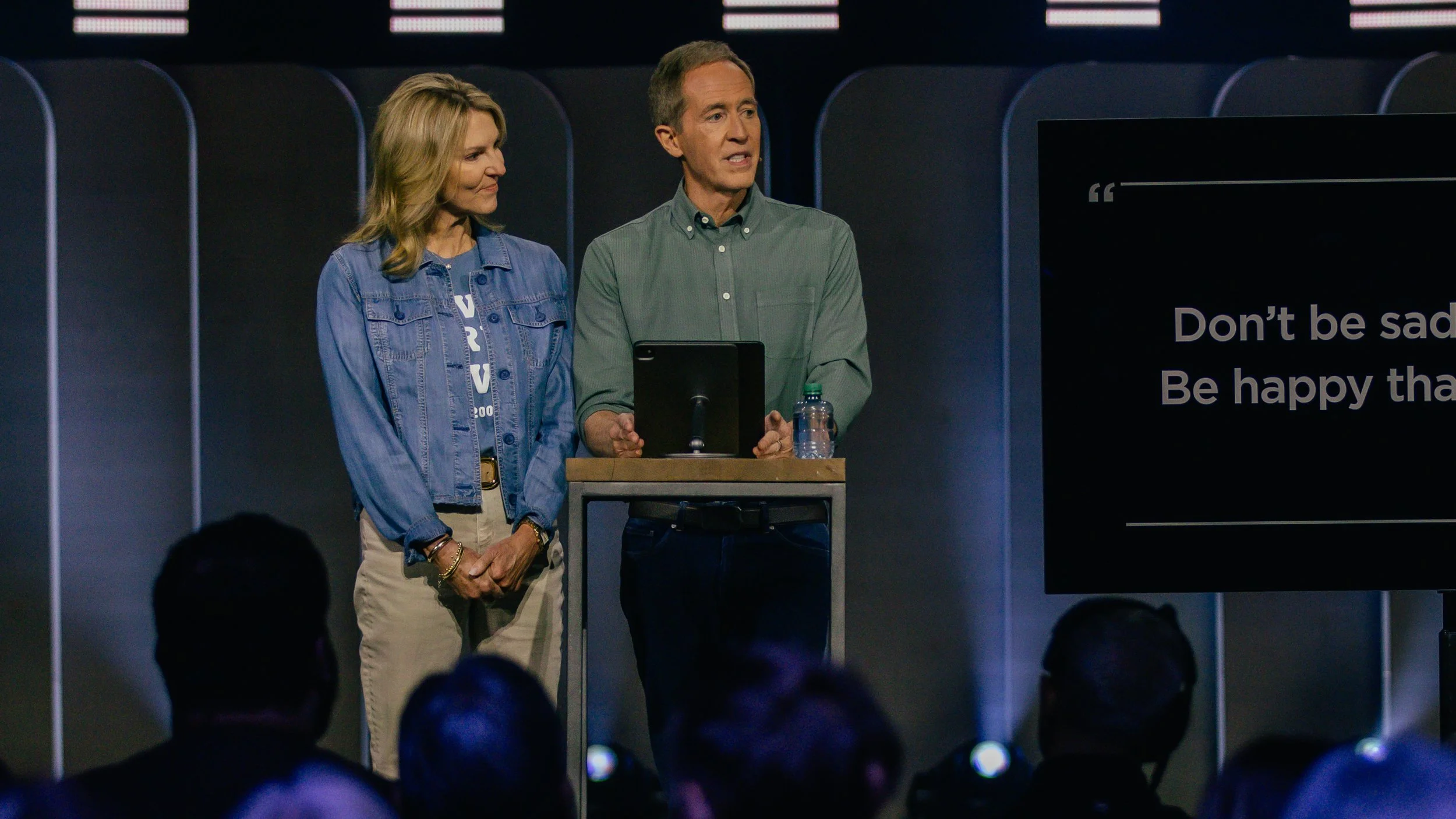
-
[If you haven't heard already, maybe you came in late or you tuned in late, today's a little bit different. If it's your first time with us or your first time in a long time, I'm thrilled that you're here for today because, as you may have heard, you're going to get a little inside peek into what's going on and what's about to go on. People keep asking me about today, saying “How do you feel?” And I say, “I feel great because I'm so confident in what I'm going to talk about, that it's the right decision and right time, and we're moving in an amazing direction. So it's a bit of a business meeting, as you may have already heard, and that doesn't mean it's going to be boring. It just means it has to be a little bit different because there's kind of a legal aspect to this that's not important to you, but it's important for the people who care about legal things, and we care about legal things as we move forward.]
[So today, I'm going to share my transition plan for handing off my two positions as senior pastor or point leader for the whole organization and lead pastor of North Point Community Church. These are phrases that you're not familiar with because we don't talk about this too much. We talk about lead pastor from time to time. So here is a very simple, actually simplistic chart of the organization to help you understand exactly what we're talking about for the next few minutes. We have a board of elders or a board of directors, as you probably do in the organizations that you work for or work with. The NPM senior pastor is really the senior leader, and that's one of my roles. Then there are all the campuses. We have eight in the Atlanta area, and then we have all the other things we do.]
[So this is a scaled-down version of our whole organizational chart. So I'm the NPM Senior Pastor, and I also have the role as Lead Pastor of North Point Community Church, where I'm speaking from today at North Point Community Church. So now that that's kind of clear, hopefully before I talk a little bit about why I've made this decision and why now and who, something to consider to frame this up. And this will be super relevant for some of you, but it will be relevant for all of you at some point down the road, especially for those of you who work in the marketplace and have long-term careers. For somebody in my position, there are really only three exit options open to me. Here they are: death, being asked to leave, or choosing to leave. So I feel like, though you may disagree, I feel like I'm choosing the best of the three options.]
[So I just want to put that out there as a framework for what we're about to talk about. Here's the backstory. About four and a half years ago, Sandra and I began the conversation around how long I should remain in my current roles as senior pastor or point leader for the whole organization and/or lead pastor for North Point Community Church. Basically, how long do I want to be an employee of the organization? And we knew, based on our experience, broad church experience, and growing up in church as a preacher's kid and hearing all the stories, we knew that what was best for the organization and for our network of churches was for me or for us to set a departure date and then to prepare the organization for that date. And then—this is where sometimes people who do what I do blink at the last moment—stick to it.]
[But to be honest, it wasn't just the organization's health and my concern for the organization that was behind our decision. The other part of this is I want to be able to say yes to my grandchildren without having to check my schedule. So for those of you who are grandparents or are headed in that direction, you get that. And that's super important to me, and I know that you're glad that's important to me. So it's both a professional thing and an organizational thing, and obviously these decisions are personal as well.]
[So I shared this information several years ago. Of course, when something's four and a half years away, it's like it'll never get here, but it does, doesn't it? Anyway, as we began moving toward that date, I essentially decided that by my 69th birthday, which will be this coming May, I no longer wanted to be, or should be, an employee of the organization. So, as we began planning for that, I met with a subgroup of our elders. Again, our elders serve as the board of directors, and I'm accountable to them. I began to meet with several of our elders and said, "Hey, this is a decision we've made. We're certain this is what we want to do. So let's begin to back up and plan accordingly." Many of our elders are here today. Our elders attend different NPM campuses, but several of them and their wives have chosen to be with us this morning, which I appreciate so much.]
[The idea was to plan to ensure that this very important, growing, and expanding network of churches, this organization, was positioned to thrive without my direct involvement, which meant, at some point, replacing myself. Over time, it became evident to me, many of you, and to our elders that the best person to replace me as the senior pastor or senior leader of the organization is, in fact, Joel Thomas.]
[But neither our board of elders nor I have the authority to replace the senior pastor. So let’s back it up a little bit. Thirty-one years ago when we started the organization, I wrote the bylaws and constitution for our church. Then I gave it to some very smart people and some attorneys to make it legal and to make sure we were all buttoned up in the way it needed to be. When we planted the church, we did so as a single-site church. Here in Alpharetta, we just thought there'd be one church, and I'd be the pastor of one church, so the constitution reflected that. Over time, as we grew into a network of churches, we have amended the constitution several times, taking into consideration the different type of organization we have become. But there were two things I insisted on not changing.]
[From the very beginning, I insisted, number one, that the person in my role, the senior pastor, was accountable to the elders or our board and that the board could fire me for cause if they ever felt like they needed to. In other words, if I went off script theologically, morally, ethically, or for whatever reason. When you're making a big decision like that for senior leadership to move a senior leader, there's usually a lot of complicated information, and it can only be understood and discussed by a small group of people. So I insisted that I could be fired by the elders and so could any senior leader. But at the same time, I insisted that the elders not have the authority to hire and install a new senior pastor without congregational approval, because we're a church, and a church should have the opportunity to choose its next leader.]
[So it was a little bit of a hybrid of a traditional church structure, which means that about 50,000 of you will have an opportunity to vote on whether or not to approve Joel Thomas as the next senior pastor or senior leader for the organization. That's right. There are 50,000. I'm going to explain exactly who those people are in just a minute and tell you how all that will work. Along with that, I'm going to give you some information about my continued involvement. So please don't sign off or leave early. If Joel is elected, and I certainly hope he is, he'll step into the senior pastor role on January 1, 2027. I will continue to serve as the lead pastor of North Point Community Church until May 2027.]
[In May, Joel will step into the lead pastor role at North Point Community Church as well, which will be for the second time, which some of you remember. For some of you, this is new information, so I'll fill you in in just a minute. So about Joel… most of you know if you attend one of our other churches or campuses, and most people in the community know Joel as the guy who draws on the chalkboard. This is all they know about Joel. And he's really, really good at it. Andy has one screen, but Joel has two because he can do that. Joel can write words and say different words at the same time. You should try that at home. It's amazing. But there is a whole lot more to Joel Thomas than preaching, teaching, and writing on chalkboards and communication in general.]
[As you've heard him say before, like me, Joel is a preacher's kid. He's a preacher's kid somewhat like me in that he decided when he was young that he did not want to be a preacher. Joel said, "I didn't want to be a preacher. I wanted to do something successful," which I'm sure his dad appreciated so much. Joel moved to Atlanta in 1996. He had an interview and then a job offer from an organization that was related to the Olympics. When he moved here and found out what it entailed, he decided not to take that job, but he stuck around anyway. Somebody invited him to North Point Community Church, and in his words, he said, "I didn't know church could be like this." You've heard him talk about this. In 1998, we hired Joel as our very first intern at our church.]
[We didn't even have an internship program at the time, and Joel had to go back and finish seminary. He was only going to be here for a short time, so we created a spot, and he became our very first intern. After he finished seminary, we hired him full-time in 1999. In 2000, he launched our very first college ministry and did a great job leading that. Then in 2003, he began overseeing all of our singles ministry and ran point on 7:22, which was an incredible era. Louie Giglio spoke here, and thousands of singles and college students from all over the area drove in. Some of you remember 7:22. Some of you met your spouse at 7:22. So even though Joel wasn't the primary communicator, he worked behind the scenes to facilitate that relationship with Louie and his organization and did a fantastic job once again.]
[In 2003, Joel met Jenn, his wife; she was on our staff. In fact, she served on our staff for 10 years. They were married in 2004. I know some of these descriptions don't mean anything to you, but they add just a little bit more history. In 2008, I promoted Joel to be the NPM Adult Environment Director. Joel oversaw all of our adult ministries, meaning groups, special events, classes, anything that had to do with adult ministry, and once again, did a great job. Then in 2011, we were facilitating this transition into more and more campuses. We became a matrix organization, not like the movies, but matrix organizations. Some of you work in one where there are dotted lines in terms of authority, and then there are solid lines.]
[We were kind of going (almost) to a franchise model on paper, and our systems needed a lot of attention. So I stepped out of the lead pastor role and asked Joel to step in here at North Point Community Church. So in 2011, he became the lead pastor. But here’s a little funny story about that. When some of his friends (I think they were other pastors; I didn't ask him about this, but I know the story's true) found out he was going to follow me as the lead pastor at North Point Community Church, somebody told him, “Joel, that is a body bag job.” Here's what they meant by that. In church world, the narrative goes like this. If a founding pastor or a pastor who's been at a church for many, many years leaves, the person to follow that pastor is generally a sacrificial lamb.]
[It's that you want to follow the person that followed the person. You don't want to be the one that followed the person. And that was kind of a general narrative. Even as a preacher's kid growing up, I just remember hearing my dad say, “Yep, the person that follows somebody that's successful, that doesn't ever go well, then it's a bad situation. That person leaves, and they're so glad to get the next...” So when somebody said that to Joel, that's what they were referring to: you don't want to follow Andy, you don't want to follow the founding pastor. Well, Joel did, and he did a fantastic job once again for four years. And for some of you who've been here a long time, that was really your first introduction to Joel as he began preaching more and began leading on Sunday morning. Then after four years, there was a little hiccup in all of our plans.]
[Joel took me out to lunch one day and said, "Hey, there's this church in Phoenix or outside of Phoenix, southeast of Phoenix in Gilbert, Arizona." He said, "And as you know, I've been out there a couple times to preach for them because they had to ask their pastor to leave. It was a terrible situation. The church is kind of spinning. It was a large church, large campus." He said, "Andy, they've asked me to come and be the senior pastor. And honestly, I don't want to go, but I kind of feel like I'm supposed to. Can you maybe talk me out of this?" So he didn't want to go. Jenn didn't want to go, and their kids didn't want to go. Mandy, Joel's sister, who has worked for our organization for 25 years (Mandy's absolutely amazing), didn't want him to go. Their families lived close together. Their kids were cousins, and it was just an ideal situation. I definitely didn't want him to go. But after listening to him describe and kind of tell the story, I said, "Joel, I think you're supposed to go." And he's like, "I know." And here's the thing. If you've been a Jesus follower for very long, and if you're not a Jesus follower, this may scare you. I don't know, but if you're somebody who wakes up every day and generally says, "Thy will be done. God, I want your will for my family, finances, time, career, and my friends," every once in a while, not every month, certainly not every week, but every few years maybe, you get this strange kind of nudge like, "I need you to do that, or I need you to quit doing that. I need you to pull away from that or spend more." And you can't explain it. It doesn't make sense on paper, but after a while you sit with it, and it almost feels like a moral imperative, like this is something I have to do. And as I listened to Joel tell the story and listen to him talk about his conversations with Jenn, I said, "I think you're supposed to do this. This really messes me up, but I think you're supposed to do this." And later he told me, "Andy, you were so neutral during that conversation. I began to wonder if maybe you wanted me to go." I'm like, "No, I didn't want you to go, but I didn't want to be selfish. And I've had those moments where you just think this is just something that we need to do." So in 2015, he became the senior pastor and senior leader at Mission Church in Gilbert, Arizona. He was there for seven years.]
[During that time, we stayed in touch. And after about year three or four, his sister Mandy and I would joke about this. Every other time or two, I'd see her in the hallway, and she would say, "Andy, when are you bringing Joel back?" I'd say, "I can't bring Joel back. He's got a job. He's doing a great job." In fact, he turned a very, very difficult church around. And Joel knew going in that there were going to be parts of this that I don't know, but he did something really, really smart. He's such an intuitive leader. Before he said yes to take the job, listen to what he did. He decided, okay, this is something God wants me to do. Andy's kind of like, yeah, so reluctantly. So he asked the entire board of elders, their whole board in Gilbert to fly to Atlanta for a weekend service. He made sure they were hosted, taken around to see all the environments here, and sat through the services. And he said, now, if there's anything about what you just experienced at North Point Community Church you don't like, you need to speak up now because this is what we're going to do. If you hire me, this is what I'm going to lead you toward. And they were like, “Oh no, no, this is perfect. We're in; this is what we need.” And then he bumped into another reality as it relates to people in general. People are all for change until something changes. This is just human nature. It's in me and you. It's like, “Oh, we're all for change. I didn't think you were going to change that!” Anyway, so he had to navigate that. He navigated some really, really tough situations and turned the church around financially. Attendance there went up, as they embraced a completely different model. Anyway, so he was there for seven years.]
[Then in 2021, the lead pastor at Buckhead Church resigned, and he resigned to me. After he did, it was very difficult for me not to immediately pull out my phone and call Joel. I thought, “No, Andy, don't do that. That's not smart.” So I waited a few days, because I wanted Joel to come back. If I was going to try to bring him back, it needed to be something big; he needed a big responsibility. He was out there leading a big church. So I called him and said, “Joel, here's a situation I would love for you and Jenn to pray about and think about whether or not this would be a good time to come back. You'll make your sister's dreams come true for sure.” Through those seven years that he had been away, he and I stayed in touch. We had great conversations as he navigated some of those things. So here's what happened. A few days later I said, “It's a big ask, and it's a big change. You guys think about it and pray about it.” So a few days later, we talked again. I'm going to put a quote on the screen. And the reason I know this is exactly what he said is not because my memory is that good, but as he and Jenn prayed about it and talked about it, they came up with this statement. They said they felt like this is the time, this is the right thing, this is what is best for our family and what we need to do. But they wrote out a statement that he read to me. I asked if I could share it with all of you today because I just think it goes right to the heart of his commitment to you and to us and to what we're doing.]
[So this is what he said to me over the phone. It’s actually something we wrote down. Here it is. He said, “Jenn and I feel called to help North Point become the next version of the church God wants it to be, and that the community needs it to be, regardless of what our role is.” I thought one of our staff behaviors, one of the things we teach all the time on our staff, is to remain open-handed, and that was the spirit of his response. So in the fall of 2021, he accepted the job to be lead pastor at Buckhead Church. Jenn immediately moved the kids here at the very end of the summer to get them settled in school. Joel stayed long enough to make sure that it was a good transition for Mission Church because he'd spent so much time developing new staff and a different approach to ministry there.]
[And I told him, hey, take your time. That needs to be a good transition. Since his return, Joel’s passion for and his commitment to our mission and our network of churches has been so evident. So much so that in 2023, I promoted him to become the executive director of North Point Ministries. Here's what this means, and this is significant for all of you at our different campuses. Basically, I put Joel in charge of the whole organization. He answered to me, and I answered to the board. Joel began to attend board meetings and elders’ meetings at that time. And I began to sit in on the NPM directors’ meetings that Joel was leading and just watched and listened and participated.]
[Again, I wasn't a bit surprised watching him lead. Joel's an extraordinary leader, not just an extraordinary communicator. So I guess the takeaway is this: for those of you who attend any of our churches, if you've been happy with your church over the past three years, you have experienced the leadership of Joel Thomas because he's 100%. So you have nothing to worry about. Along with our elders who were unanimous in their support, I'm convinced Joel is the right choice to take my place as senior pastor and senior leader of this organization. And just another little aside, I've been confident, and I've felt that way for a long time. Here’s another little interesting story. So about three or four years in, probably right around the time actually we went multi-site, whenever that was initially, people would say to me, not just about me, but to me, "Hey Andy, what happens to your church if something happens to you?”]
[“What happens to your church if something happens to you? It all seems to rise and fall on you if something happens to you." But the story was worse, and in almost every case it went like this. I don't know who came up with this. “Andy, if you got hit by a bus…” I was always getting hit by a bus over and over, not a truck, not a car. I'm thinking, why do I always have to die in these scenarios? Why couldn't it be, “Andy, if you won the lottery and you had so much money…" No, I died in every scenario if I got hit by a bus… anyway... But the question was, what happens to the organization if something happened to you? So a few years in, I decided that I would address that.]
[So what I did, and I don't know if this was a good idea, I wrote a letter to our elders that was only to be opened if I got hit by a bus, if something happened to me. And I made two copies, and I gave one to Diane Grant, who's been my administrative assistant for 30 years. Yeah, she deserves more than she deserves. Yeah, that’s a long time. If there were any secrets, she knows them. And then I gave the other envelope to Darcy Dickerson. Darcy is why the words are spelled correctly, and the quotes are really who said them, and all those kinds of things. In fact, I found out today that neither of them knew they had the other envelope. I didn't know that until today because I told them not to tell anybody. Darcy is amazing. So I gave it to these two ladies. I said, "If something happens to me, just take this envelope and don't open it; just give it to the elders." And the letter in the envelope said, "Dear Elders, if you're reading this, it's because I got hit by a bus." That's not what I said. “I'm not here any longer, and you have a big responsibility on your hands. You have to figure out what to do immediately and ultimately.” I said, "So I can't tell you what to do ultimately about the next senior pastor, but if I were you, based on what I know about the staff, here is the staff member that I think you should immediately appoint to lead the staff while you work through the process of replacing a new senior pastor." The first time I just looked around, because we were all in our 30s, maybe late 20s, and I guess by that time I was 40, but I chose the most senior responsible person on our staff.]
[Many of you know Durwood Sneed. I chose Durwood, and he wasn't a platform person or preacher, but I felt like the staff needs a dad, and he is mature and wonderful. So I said, "Just put Durwood in charge of the whole staff." And I didn't tell Durwood either. Imagine that surprise. It's like, "Hey, you're it." So through the years, there was always that envelope with those two individuals. Well, about nine years ago, I can't remember exactly when, I re-did it. Joel Thomas was the go-to person. He was at Mission Church in Arizona at the time. I said, "If something happens to me, if I were you, I would hire Joel to replace me. He's the person." That's how much confidence I had in him.]
[So anyway, here's how the vote will work. We don't have traditional church membership. In other words, you can't join our church. And it's okay if you tell people “I'm a member of Gwinnett Church, or I'm a member of Woodstock Church, or Decatur City Church.” People use that language loosely, but we don't actually have membership. And the reason we don't is that membership rolls get old in about 20 minutes, and then you just have a list of people. They don't even live there anymore. They passed away. They've gone to another church and didn't let you know. Meanwhile, you've got all these amazing people like all of you who are doing the work and volunteering and serving, and those two lists don't match up in any local church, especially a church that's been around for a long time. So we decided we're not going to do that after the first couple of years. So you can't join our church, but you can participate in our church. And those of you who participate, we feel like, and I feel like you should have the most influence in terms of how we make this decision and who is chosen to be the point leadership person for our organization or in church terms, the senior pastor. Because I feel like, and you would agree, the people who are doing the work, carrying the load, giving, serving, in group, carrying the model, facilitating what we're doing all over the country and all over the world, you should be the ones who make this decision.]
[So late this afternoon, about, as I said, 50,000 of you will receive an email. If we don't have your email address, you'll get a letter, but not this afternoon. You'll get an email with a link to an online ballot. Here’s how we chose who gets to vote. According to our constitution, our elders get to choose who participates as membership, so to speak, in votes. So I suggested, and they agreed, that we need to broaden the criteria to engage as many of you as possible in making this decision. And if I were Joel, I would want to know that the congregation wanted me to serve in this important position. So here's the criteria. Anyone 18 years or older who has participated in any one of the four things in an 18-month period, anybody who has participated in a small group over the past 18 months, anybody who's volunteered on a team, donated financially four times or more in any 12-month period, or checked in a child with any consistency, you're going to get the email.]
[If we don't have your email address, you'll get a letter, and you'll have an opportunity to vote. It's a very simple ballot. You can't write in anybody's name, okay? But the good news is you don't have to stand in a line either or go anywhere. It's just a yes or no. And you're voting not for the lead pastor position, you're simply voting for the senior pastor position. And the ballot, basically, this is the ballot. The board of elders has recommended Joel Thomas to serve as the senior pastor of North Point Ministries, Inc., effective January 1, 2027. And it's basically, do you agree with the elders’ recommendation? Your name and email address will already be filled in. You can vote yes or no, but I certainly hope you vote yes. And we will announce the results, not next Sunday, but on November 1, in two weeks, which brings me at last to this.]
[And basically, what am I going to do? What am I planning to do? You may not be interested in the answer to this question. Sandra is very interested in the answer to this question. So the term I've used with friends, the core staff, and with the elders who've been on this journey with us, is redeploying. I'm simply going to redeploy. I'm retiring from my job, but I'm not retiring from ministry. So I will continue to be part of the preaching rotation at our local churches. I'll continue to preach, not as much perhaps, but I'll continue to be part of the preaching rotation. I'm already on the schedule for next fall. I've asked if I could do the Be Rich message again next fall. Everybody's like, "Please do it. We don't want to do that." I'm also planning to use some of my spare time, my extra time, to continue to be an ambassador for our church network, both nationally and internationally. Next fall, I'll be in Scotland, Ireland, and the UK working with church leaders because... I'm going to do a deep dive on this next weekend. Please don't miss next weekend, even if you just have to watch online if you're traveling. But what is happening is so significant and moving so fast internationally, and it's because of what you do day in and day out, week in and week out, with your generosity and with your service. It's incredible! So I want to be wind in the sail of that endeavor. And then two weeks ago at our elders meeting, Joel and the elders said… okay, because I was going through this whole presentation… and they said, "Well, would you be willing to continue serving on the board of elders?" And I'm like, "Absolutely. If you elect me, I would love to continue to serve as an elder, but again, that will be up to you." So I'm planning to continue to be involved.]
[I'm not going to disappear. This is the part of my script that, every time I read it at home, makes me emotional. So I'm going to try to power through this. But here's the thing: this is our church. It's our children's church, and it's our grandchildren's church. So we're not going anywhere. We love this church, but I am absolutely convinced that the best thing for this next iteration of what we're going to do together is a younger leader who can project a vision further out than I can because of my age and season of life. And I'm not trying to be the hero. I'm not trying to be a martyr. I just believe in what we do. And that's one of the reasons I'm confident this is the right time, and Joel is absolutely the right person. So quick story and I'll wrap this up.]
[About a year and a half after we started the church, late 1996, maybe early ’97, I was 38 years old. We had purchased this property. I'm again in Alpharetta today for those of you watching. We purchased 52 acres and people are like, "What are you going to do with 52 acres?" I'm like, "No, I just think we should buy as much land as we can." We'd hired an architect, but we didn't hit go because we didn't know what we wanted to build. And the challenge was we didn't know how big to build the main auditorium because once you choose the size of the auditorium, then you know how much children's space and middle school space and high school space and office, everything kind of goes ratio-determined. The ratios are determined by the size of the auditorium. And we had about two and a half million dollars of debt, and we had scraped every dollar together to buy the land. We were just kind of dreaming at that point. But we were trying to decide how big to build this auditorium.]
[So John Maxwell had just moved to Atlanta not too long previous to that with his whole team, moved to Atlanta. And it's kind of funny how I met John. I've been listening to his tapes. You remember cassette tapes? Anyway so I'm at a restaurant with Randy Pope, who was the pastor at Perimeter Church. Some of you know Randy, I love Randy. And we're having lunch, and I hear this deep voice somewhere, and it's John Maxwell's voice. I'm like, Randy, John Maxwell is in this restaurant. I recognized his voice, stood up, looked around, and there he was. And I did the very thing I always hated that people did when I was having lunch or breakfast or dinner with my dad when I was a kid growing up. I just got up out of my chair, and I ran over there, and I said the very thing that always bugged me when people would say it when I was a kid, I said, "I don't want to interrupt..." Well, then, why did you walk over here and interrupt? Did somebody make you? That's what I would always think. People say, “Dr. Stanley, I hate to interrupt...” I'm like, I don't think you hate it. Okay, that's just the kid. So if you see me at a restaurant with Sandra, please interrupt. You're going to go, "Oh, no." Anyway, so I ran over there, and I'm fangirling like crazy. It's John Maxwell. Anyway, that's how I met John. So I'm surprised he took my call later. So I asked John to go to lunch because, if he didn't know, he's the leadership guru who's written a gazillion wonderful books on leadership, but he was a pastor for many, many years and in a difficult environment in terms of facilitating construction in California a long time ago. So I thought, I'm going to ask John what we should build.]
[So I had a lunch appointment at a restaurant not too far from here, and he gets there, and I'm kind of nervous. And because I was going to ask him about the size of the auditorium, I brought all this information. I was sure he was going to want to know our P&L, how many members were trying to figure that out, how much debt we had, just all the stuff. I'm ready for all his detailed questions. He sat down. A waitress came and took our drink order and left. I said, "John, I know you're so busy.” Because I didn't tell him what I wanted to talk about. I said, "I just have one agenda item.” I said, “How big should we build? How big should we build our auditorium?” And he immediately shot back, “Well, Andy, how long do you plan to stay?” Yeah, you laugh. I thought, what does that have to do with how big of a building we build? How long do I plan to stay? I remember I wrote down what I said. I said, "Well, I planned to be at the church for my whole career." I remember I used the phrase, "I want this to be my life's work." I don't know where that came from. And he shrugged and said, "Well, then build it as big as you can.” And we hadn't even ordered our lunch yet.]
[So we built it as big as we could. And I still remember the floor was tiled back then, all tiled, and there were no chairs yet. I would come almost every weekend. I would drag my kids up here to walk through the building under construction. And I'd stood there, and they had just unloaded the chairs out in the parking lot. And I stood here, and I looked at this giant room and I thought, “Oh no, we've overbuilt. What if nobody comes? It's so big.” And then we added a balcony at the last minute. And people say, “Andy, all this stuff is happening. Was that your vision?” And my standard answer is “No, it's not my vision. We passed my vision at year five.” After that, Sandra and I, in fact, you should come up here. Come up for a second. This is my support wife, emotional support wife. Thank you. Because this is the part I'm like, I’ve got to power through it. Ever since, five years later, we have just been hanging on. In fact, our prayer, I promise I'm not making this up. We would pray, dear heavenly Father, please don't let us mess it up. Yeah. Help us not to mess this up. We were just along for the ride. And so nobody is more grateful. We've never struggled with taking credit for what's happened, not because we're so humble, but because it is so far beyond anything we imagine. Why God chose to supercharge and fuel inject this movement, we'll never know, and it's really none of our business, but we are so, so incredibly grateful that this has been, as I said that day kind of by accident to John, that we've had the privilege of making this our life's work.]
[So I'll wrap up quick. There's an anonymous quote. I thought I'd heard that Dr. Seuss said it, but Darcy Dickerson told me that Dr. Seuss didn't say that. Nobody knows where this came from, but we've sort of been hanging onto this in this season. It says this, "Don't be sad that it's over. Be happy that it happened.” And we are so happy that... Thank you. Thank you. Thank you. You can remain standing if you want. I'm done. I've said it three times. That's another preacher thing to say, “last thing.” People who've known about this keep asking me, and it's an appropriate question, are asking us, "How do you feel? How do you feel about this?" And we feel grateful and confident because again, we're confident this is the right decision. It's the right time. And Joel is definitely the right person. And we as a network of churches are so fortunate to have somebody like Joel who has been a part of this journey for so long and has such varied experience and then came back. So I would just ask two favors. Number one, please come back next week or tune in next week as I backfill some of this. It's so important. And then number two, please vote and please vote for Joel. Thank you.]
© 2026 Andy Stanley
All Good Things • Part 2: Up in the Mix
Andy casts a compelling vision for the future of our expanding network of churches while underscoring what needs to be turned up in the mix in churches everywhere.

-
[So I want to welcome all of our partner churches around the country, our Atlanta-area-based churches, our friends down on the south side, like Oconee Church, and on and on it goes. As I say, every once in a while, it's so exciting to be a part of an expanding network of churches all over our country, more and more all over our world. We actually have a three-day conference this week for our pastors mostly from the United States, a few from different parts of the world that are close by. And when I'm with these men and women, it's just so rich, and it's so powerful. And I wish everybody at all of our churches could just see the difference you're making in places you won't visit with people you'll never meet.]
[So regarding my announcement last week, which, everywhere I go now, people congratulate me on retiring. I was voting yesterday, and people are like, oh, congratulations. Anyway, so it came as a surprise, I'm sure, for most of you. And while preparing for last week's message, which took a lot of preparation, I kept thinking, what am I going to talk about the next week? Do you just kind of show up like that didn't even happen? And the answer is no, I don't want to do that. So today, real quick, and by the way, if this is your first time with us or the first time in a long time, or you're watching or you're from a different faith tradition, maybe you used to be a Christian and somebody's making you watch or brought you to church today hoping something would catch your attention, I am so glad you are here today because we're going to talk about what's most important to us as a group of local churches.]
[And it may be different from what you heard growing up, and it may be an on-ramp back to faith for you, not necessarily back to our church, but just back to faith. So anyway, today I want to reiterate and elaborate on something I mentioned briefly last week, and specifically, my commitment, my personal commitment, really our family's commitment, but my personal commitment to what we've been doing corporately and what we're going to continue to do. In fact, my commitment to what we're doing is part of the reason, in fact, it’s actually a big reason why I chose to step back earlier than I had to or earlier than I even needed to because together—and this is the part I wish you could see—together we are literally helping to reshape, reimagine, realign the church, the church in general, with the teaching and the kingdom agenda of Jesus.]
[And we're doing this literally locally in the Atlanta area, nationally, and more and more globally. And here's the thing, our team, we try to do our best to kind of keep this in front of you appropriately. We don't need to talk about it every week, but for years we didn't talk about it at all. And we try to do that through our Deeper/Wider updates where you get a picture of what's happened in different parts of the world, different parts of the country, or even different ministry environments. But I get it, you're busy, and you're actually busy doing the things you should be focused on: your family, your work, your school, those kinds of things. But your engagement in our local churches and your participation in terms of serving and giving and representing and inviting, all of that is moving the needle for churches and church leaders all over the place.]
[And for me, and the reason stepping out of employment is different than retirement, for me, that's never been a job. For me, for over 40 years, I felt like it was a mandate. Even more than 40 years, when I used to teach high school students and college students. And I don't want us, and I mean corporately us, to lose momentum. And just one more thing personally, the temptation, and I say this because I've heard from so many of my pastor friends around the country who are shocked, like, "Wait, what?" The temptation for somebody in my position is to stay put because my job has never been easier. I control my schedule, I control so much of my time, I can preach as much or as little as I want. So in some ways it's never been easier. But here's what I've seen, and here's the way I see this.]
[Easy for me is a recipe for a loss of momentum, and what we're doing is too important to lose momentum. And I've seen that. I don't want to participate in that, and I certainly don't want to accidentally facilitate that. Now, our original vision, and again, personally, my original vision when I started doing what I was doing and we came out here, was just one—all I wanted to do was help create one great church and one community, an outward-facing church committed to the teaching of Jesus, elevating the teaching of Jesus and connecting people to the teaching of Jesus and clearing out all the unnecessary clutter that sometimes gets in the way as people begin or continue or come back to a faith journey. And so because what happened went way beyond this, and I said this last week, it is so easy for me and so easy for me and for Sandra not to take credit for what's happened and to maintain, or I should say to remain extraordinarily grateful, but in addition to being grateful, to also feel accountable—accountable to steward what's happening and what you're doing responsibly.]
[And part of that stewardship is doing everything I can using my influence, doing everything I can to ensure that we as an organization are prepared for the future and that we have the leader and the leadership necessary to take what you've begun and what we've begun into the next generation. In other words, in some ways to do for another generation what we did for this generation. Did you know a generation is generally assumed to be about 30 years, and our church is 31 years old. So the question for me, and I was challenged with this question many years ago interviewing a business leader, who decided to step out of his role at a business all of you have done business with, because of this way of thinking. He said this, and this marked me, this was years ago, he said, "Andy, I realized that the issue for me wasn't so much when am I ready to step down, but when is the next person ready to step in?" And I thought that is such a mature and kind of Christlike way of thinking about a leadership transition.]
[I've never forgotten that. So really, the question for me was not so much when am I ready to step down and hand off leadership, but when is the next person or the next group ready to step in and take the reins of what we're doing and lead it and take it into the future to take things even further? And I didn't get to talk about this last week, but it's so important to me. So please just bear with me a minute. I wasn't the only one, and I'm not the only one asking that question. There are four of us that are basically founders. In other words, we were in the first little group that got together to say, let's plant a church in Alpharetta. And the other three gentlemen, some of you know some of these gentlemen, Rick Holliday, Bill Willits, and Lane Jones.]
[Rick Holliday has been the business administrator and created all the business systems. He's basically behind all the architecture, the buildings, the construction, all the stuff that I didn't know anything about. Rick and I went to college together. I studied hard and made B’s. He slept through most of our classes and made straight A’s. He's one of the smartest people I know. Most of you don't know Rick, but you have been so directly impacted by Rick Holliday. And again, Rick and I were roommates before either of us met our wives. Bill Willits engineered and created the whole small group structure that's been such an integral part of our church for years and years and years and really created a fresh approach to small groups for churches all over the country and all over the world. He wrote the book that people have used as a textbook. Lane Jones. Lane Jones, he can do anything. He led worship when we first started. He was the first lead pastor at Browns Bridge Church when we started that church. And for the past several years, lots of years, he's overseen and led all the campus pastors at all of our expanding campuses.]
[So these three gentlemen are amazing. But let me tell you what's most amazing about them, and it underscores what I'm trying to communicate. Three years ago, I went to them, and I said, hey, I want to elevate Joel Thomas to be the point leader for North Point Ministries. I think that's the right move for the future, three years ago, which means you three guys, instead of reporting directly to me, you're going to now report to Joel, who's younger than you and has not been in the organization as long as you have. In fact, Bill Willets hired Joel as the first intern in the organization. That's the nature of these relationships.
And I'm telling you, all three of these guys immediately said yes. And I'll tell you why. Because the mission of this organization has always been more important to them than their position in the organization. That's the kind of leadership you've had, and that's the kind of leadership we've benefited from. And that is our commitment to the future.]
[Now, backing up a little bit or moving on a little bit, you may remember if you've been around since the inception of our Deeper/Wider initiative, it's a two-year financial initiative in order to raise about a hundred million dollars above our normal giving in order to invest in the future. That's what it's all about. Many of you have given generously. Some of you are still fulfilling your commitment. Some of you haven't started yet, but I know you're just saving it up because you love to come last anyway. So I know you're working on it. But anyway, if you'll remember when we launched this, if you were here for that, you might remember this. We said it's a two-year initiative. In other words, we're giving for two years a five-year investment of this money in the future of the network and getting our facilities to the place where they can move into the future healthfully and a ten-year impact. In other words, five-year investment, but there's going to be leadership wind in the sails to make sure the impact is at least ten years. And the point of me rehearsing this with you is that the four of us founders should not be leading this organization ten years from now. So it was important for us to begin stepping out and allowing some other people to step in because this is a big vision, it's a big picture, and we think it's going to continue to impact churches, we hope maybe for generations.]
[And that brings me to this, which is really the main thing I wanted to communicate for the next few minutes. That was all kind of the prelude. And this next part is why if you're not a Christian or you just have strange thoughts about Christianity in general or the Christians you've met or the church or maybe you had a bad church experience, this next part is why I'm so glad you're here or at one of our churches or watching today. And I'll set it up this way. What are we doing? What are we doing that is so important? Why do we think we're such a big deal? What are we doing that's so important that we dare not content ourselves with just being another collection of local churches? I mean, who do we think we are? What's all this talk about local and national and global?]
[Did somebody die and leave us in charge of the church? No, that's not the way we think at all. Again, we had a little bitty vision, and I can only give credit to God and the extraordinary people I'm surrounded by in terms of what has happened since then. But the best way to describe why we are thinking so big and broadly and why we're so committed is simply this. We are attempting, we're not even attempting, we're doing this. We, collectively, even though you didn't know you were a part of it, are turning up the good in the good news. Now let me tell you what I mean by that. Good music that's mixed poorly comes across as different music than it's designed to be. Good music mixed poorly can actually be experienced as bad music. If you can't hear or understand the lead vocal, you won't know what the song is about if it's mixed poorly.]
[And here's the thing: the words of Jesus are the lyrics to the song that the church was created to sing, that Jesus is the lead vocal. And without using that language, he said as much, and some of the most famous things he said, things that you could probably quote, and if you're a pastor, you've preached on this dozens of times. At the end of his earthly ministry, he gathered his followers together and he gave them a charge. And what he said, again, we've heard it so many times, but these statements are the statements that have gotten lost in the mix with everything else in the Bible. And these are statements that need to be turned up in the mix. And these are statements that we've been trying to turn up in the mix for a long, long time and are continuing to. And more and more church leaders and more and more Christians are going, yes, that not only makes sense, that's the way it's supposed to be.]
[So here's Jesus's version. He gathers with his disciples and a bunch of others to give them their last charge before he leaves, and he makes this crazy statement. Only a crazy person would say this or it must be true. And we'll talk about why they knew it was true in just a minute. Here's what he said. All authority, all, like every bit of it, who would say this, all authority, not simply on earth, all authority in heaven and earth, which means I can call the shots. I'm the connector. The temple was where heaven met earth. You're looking at where heaven meets earth. That's what he means. It's so powerful. The temple has had its purpose. It served its purpose. You're looking at where heaven and earth meet. All authority in heaven and earth has been given to me—implication, he makes it clear, given to me by my Father in heaven.]
[And here's what these Jewish boys and girls heard. Moses was your guy. I'm your guy. Moses was your guy, and Moses served a purpose to set up for what was coming. But the finality, the reality as the apostle Paul says, is me. The King has arrived. Everything before pointed to me. The King has arrived. It is a brand-new day. I'm introducing a brand-new way of life. And then he tells them what he wants them to do. He says, I want you now to go into the whole world. This is amazing. These are people who had to walk everywhere. Most of them had been maybe 40 miles from home in either direction. And they're just this disenfranchised band of men and women who have no influence. He says, I want you to tell the whole world. I want you to teach the whole world.]
[And they're like, what are we supposed to teach? Now listen to these words. He says, all authority on heaven and earth has been given to me. I want you to teach the whole world. What do we teach? Teaching them to obey everything I have commanded you. Teaching them to obey everything I have commanded you. Jesus says, I'm the lead vocalist and my words are literally the words of God. Now here's the challenge, and here's why what we're doing collectively is so important.]
[When Jesus's words are equated with, versus elevated above, all the other words by all the other authors in the Bible, his words get lost in the mix. And we're going to change that. We're going to help church and church leaders recapture the original mix by turning up or continuing to turn up the words, the agenda, and the identity of our King. Now, I think this is more important than ever. And that's why it needs to go way beyond me. It's more important than ever because even good church people and even people who've been Christians a long time seem to be more confused than ever about the identity and the claims of Jesus and the priority Jesus should get over every other person because he said, all authority rests with me and you are to teach what I have taught, which means everything before Jesus pointed to him and everything written about Jesus by the apostle Paul or Peter or Jude or John points back to what he taught and simply elaborates on what he taught because they were there, several of them were there when he said, teach what I've taught.]
[So that's exactly what they did. They weren't adding to, they were simply commentating on. But when the mix of our faith is, or when the music of our faith is mixed properly, when Jesus once again becomes the lead vocal, the good news of great joy. I mean, the angel said it, right? I mean, we celebrate it at Christmas, but it's not a Christmas story because there wasn't a Christmas at the time. Remember what the angel said to the shepherds? I mean, here it is. How did we miss it? This should be elevated. Remember this? The angels appear to the shepherds. Do not be afraid, they say, for I bring you good news. I bring you what you're about to discover, and they're stating it to shepherds who are very disenfranchised from society because of what they did. I'm bringing you good news, and listen to this part, of great joy.]
[In other words, when people understand this, they're going to be happy about it. When they hear this, they're going to light up. They're going to lean in. I bring you good news of great joy, which will be for, let's just say this together, all the people. And people are going to lean in.]
[And then here's the next part. And what is this good news? What is this good news that the angels are announcing, what is so good about it that it should be announced in this dramatic kind of way? What is this news that should be so far up in the mix that it's unmissable and unmistakable? And I'm going to read it to you, but I'm going to do something a little different. In the Greek language, and the New Testament was written in Greek, they didn't have punctuation. There was no bolding, italicizing, or underlining or highlighting, or you couldn't put certain words in red or green to highlight them. So the way they emphasized something was by stating it at the beginning of a sentence. So instead of saying, and what's interesting in many cases, if you read it that way, it sounds a little bit like Yoda. In other words, instead of saying, “I love you,” it would be, “Love you, I do.” Why? Because love is the point of it, not me. I, I'm not the point. Love is the point. Love you, I do. So I'm going to read this next verse the way it's written in the Greek because I want you to feel the emphasis of this because this was the emphasis. This is what made it good news. Here it is. Here's the good news, the angels announce. Born for you today, born for you today. In other words, he said to the shepherds and to the world, this is for you because God is for you. For who? For everyone. Born for you today, for your benefit. A rescuer. Born for you today a rescuer who is Christos, God's anointed one, God's final King. He will be the boss. He will be later on, they would understand this to mean, and he is divine. He is God in a body. Born for you a rescuer, not that God sent, but that God has shown up as. A rescuer is born for you in the town of David. The least consequential part of this was “in the town of David.” The most consequential part is it is for you, and it is for the world.]
[Now here's the thing that you know, and maybe for some of you, this is your story and I'm so sorry. People don't resist or exit the church because the news is so good, so inspiring, so compelling, so practical, and so helpful. It's like, I just can't take it anymore. I can't go back to church. It's just too good. It's too helpful. It's too inspiring. I keep getting better and better and I just can't handle any more better and good. That's not why people exit the church or leave the church. The version of faith that most people or that many people choose to leave sometimes and all the times is a version that's so watered down and mixed incorrectly that it's, in some cases, I don't even know if it's worth sticking around for. And I listen to lots of preachers, and I just think, ah, look, it's not the good news. And none of this is original with me. If you're original and a pastor, you've done something wrong. The goal isn't originality. The goal is to understand what the Scripture clearly teaches and what the New Testament clearly teaches. And this is so clear. It's not what oftentimes people hear, it's not the good news, it's not the original news. And we want to change that. Or to say it in a kind of a rhyming, snarky way, we want to fix the mix. It's what we want to do. And not want to, this is what you’ve been doing. This is what we've been doing. We want to restore the mix.]
[Now, this next part is a little nerdy, okay? And some of you are going to be like, Andy, now you're just making stuff up. So I just want you to know if after the service today or after you watch today, you're like, you went too far, Chat will help you. Claude will help you. Google will help you. There's so much help. So I would love it if you would double-check this because this is so important. One of the culprits, I think, in my opinion, a big culprit as to why the teaching of Jesus got lost in the mix of everything else in the Bible, that one of the culprits behind kind of the erosion or downgrade of Jesus’s good news is this, don't leave early or turn off early, is this term, gospel.]
[In our culture, people think the word or use the word gospel as if it means truth. “I'm telling you, that's the gospel truth.” And you might have heard maybe your granddad or dad say, "That's gospel." What are they saying? They're saying, "That's true. You can rely on that." But the word gospel, this is super important, the word gospel is not a translation of the Greek term it coincides with in our English text. The word gospel actually comes from an Old English term that you've heard before maybe: godspel. In fact, how many of you remember the '70s musical Godspell? Yeah, about eight of us.]
[And I remember as a kid, this was in the '70s, and I remember when Godspell came out, it was like Christians are like, "Oh, what is this? A spell? They're using God." But this was an Old English term, and everybody who read this, it was a very common term, it showed up in all kinds of literature. It was not a religious term, and everybody knew what it meant. It meant good news or good story. “Oh, that's gospel. That's a good story. Oh, that was godspel. That was gospel.” Anyway, I'm almost done with the history part. Everybody who would read an English text, and there wasn’t a lot reading going on because the printing press hadn't been developed yet, and the Bibles weren't easily accessible, especially the New Testament or the Bible in general, but everybody reading a New Testament in the 12th or 13th century saw the word godspel, and they understood exactly what it meant.]
[Then something really interesting happened, interesting to me, people like me. In the 13th century, for some reason, the “d” was dropped, and that's where the term gospel came from. It was no longer godspel, it was gospel, but everybody knew it was the same word, and it meant good news or good story. And then in 1611, something monumental happened, and don't hear me being negative about this, this was good. In 1611, King James authorized a version of the English Bible. And when the king authorized it, it meant, hey, everybody should have access. This is the official Bible. And this is amazing. The King James Bible was published in the year 1611, and it was the primary English text for hundreds of years. In the colonies, the King James Bible was used to teach kids how to read. So for hundreds of years, the King James Bible is the primary Bible. In fact, today, there are many people who use the King James Bible. There are people who will get kind of ferocious and angry if you say they shouldn't use the King James Bible. And every once in a while, not much anymore, but back when people would talk to me about these things, I would say, "Look, would you allow a doctor trained in 1611 to do surgery on one of your children?" And they're like, "No." I'm like, "Well, then if you wouldn't trust the medical practices of 1611, why should you trust the scholarship of 1611?” Because since the King James Bible was created, we have found older manuscripts and better manuscripts, and our modern translations of the Bible are better translations. But because King James has been predominantly used all over the world as the primary English text, the word gospel is here to stay because the word gospel appears in the King James Bible. We've been stuck with it ever since.]
[Now, here's the bottom line. Bottom line is simply this. Every reference in your New Testament, whatever version you read, every reference to the term gospel, εὐαγγέλιον yoo-ang-GHEL-ee-on is the Greek term, every reference should instead read good news because that's what it means. Now, some of you are thinking, Andy, you're about to lose me in this. Did you just run out of stuff to preach about? I mean, is this really a big deal? Are you kind of razzle-dazzling us to make us know that you're smart? Uh-uh. This is a big deal. And here's why. Okay, ready? Look up here. Here's why it's a huge deal. When Old English godspel became modern English gospel, the good news was literally lost in translation because good news, the phrase good news raises the bar and clarifies the message. In other words, what if all our lives had been the good news of John instead of the gospel of John, the good news of Matthew, the good news of Mark, the good news of Luke. It's like, whoa, what's all this good news? It forces people to ask the question, what's good about it? And it raises the bar, and it creates a point of evaluation. Hey, that doesn't sound like good news to me. Maybe it's not the correct news. Maybe something's been lost in the mix because good news raises the bar and clarifies the message. So instead of, again, the gospel of John, right? The gospel of John, it should be the good news of John, the good news of Matthew, the good news of Mark, the good news of Luke.]
[Now, confusing matters even more is this. Our modern English translations, and I know, I'm telling you, when I say things like this, people go, "Oh, Andy doesn't believe the Bible." If you knew how much I loved the Bible, and as an empty nester, I get to spend as much time every morning as I want studying, not preparing sermons, studying the Bible, I love it more and more and more. But look, confusing matters even more, our English translations, our modern English translations aren't even consistent. And you look up the same verses and one version says gospel, one says good news. Really nerdy stuff, the verb form of εὐαγγέλιον yoo-ang-GHEL-ee-on is always good news. The noun form is usually gospel. So there's inconsistency, and I'll tell you why, because a little publishing secret, because the King James version and some of the terms in the King James version are so entrenched in Christianity, you don't want to publish an English text that's too far afield of what people expect and people are accustomed to and seeing the word gospel. But the term gospel blunts the sharp edge and the clarity of Jesus's message. It actually diminishes the eye-popping contrast between what he brought to the world and what every other religious system brought to the world. Because if somebody claims, "Hey, I've got good news." If somebody claims good news, if good news is the lead, if good news is the headline, you’ve got to put up or shut up, right? "I've got some good news." Okay, prove it to me. Announce good news and you've raised people's expectations, right? And the news better be so good. The news better be so good that people will want it to be true, even if they have a hard time believing it's true.]
[Now, here's the sad part. There will always be, I guess, there always are, and there will probably always be Christians who are threatened by how good the news really is. There will always be those inclined to turn the good and the news down in the mix. And the reason I know that is the case is because that trend started just a few years after the resurrection of Jesus, because the Judean Christians who were so accustomed to an Old Testament framework or an old covenant framework, they just couldn't get past the fact, it can't possibly be that way. In fact, the apostle Paul, who was a Pharisee who thought that this is not good news at all, became a Jesus follower and was like, "Oh my goodness, it's even better than I expected." The apostle Paul writes a letter to Christians living in Galatia, the Roman prophets of Galatia. And in that letter, if you've read the book of Galatians, it's in your New Testament, the entire book of Galatians for the most part is his defense of the goodness of the good news because Paul understood better than anyone because of what he was and what he became. He understood better than anyone just how good the message was, and he defended it more passionately than anybody else. And if you know the story of what happened, he went all around the Mediterranean rim creating these little ecclesias, these little house churches or networks of house churches. And for years, Judean Christians would leave Judea and go to those same places and visit those same churches and say, hey, we know Paul was here and Paul had it mostly right, but you need to dial it back a little bit. You need to dial it down a little bit. There's more to it than he let on, when the apostle Paul found out about this. This is why Galatians is like, "Whoa, did you just really say that?" I mean, the English text kind of dumbs down a little bit. He's so graphic. I won't go into that. It deals with circumcision. You can look it up for yourself. Anyway, he was so angry because they attempted to strip away some of the goodness and the mercy and the love of God because they couldn't fathom the depth of grace that Paul insisted Jesus had modeled—read the Gospels—and introduced to the world.]
[So consequently, he is furious. He insisted and he knew. He insisted that the arrival of Jesus, that the arrival of Jesus was good news for everybody, and he died believing that. Now, got to wrap this up. So you get to Matthew, Mark, Luke, and John, and I'm telling you it's all over the place, and it's why we need to turn it back up in the mix. It's very clear what they're communicating to us. Here's a couple of examples. Matthew, who was there for all of it, Matthew who was probably wealthy, Matthew who had scribes working for him. That's why there's so much incredible detail in the good news of Matthew, instead of calling it the gospel of Matthew. But listen to this little snippet. This is amazing. Matthew's there for this. This isn't like “I heard about it.” He says, Jesus went throughout Galilee, the whole region north of Judea. Jesus went throughout Galilee teaching in their synagogues, proclaiming the good news. Now, some of the English texts have gospel there instead of good news. Proclaiming the good news of what? Of the kingdom. And get this—and healing every disease and sickness among the people. And who did Jesus heal? Good news. He healed people who needed healing regardless of what they believed and regardless of what they believed about him and regardless of why they were sick. And this was an era where it was kind of karma. It's like, well, the reason he's blind, the reason he's lame, the reason she can't hear is because either she did something wrong, he did something wrong, or their parents did. So Jesus, aren't you concerned that you're kind of messing with the whole way the world is designed? I mean, you're just going to indiscriminately heal all these people lined up without knowing why they're sick? Jesus said, yes, because the King has come. A new age has come. The kingdom of God has come.]
[Mark, who got his information from Peter, because Peter was illiterate based on what we read in the book of Acts—he was a fisherman, he was a day laborer, he didn’t have time to learn to read and write. Here's what he told Mark about his time with Jesus. Hey, I'm telling you, he says, I was there. We went into Galilee and Jesus was proclaiming the good news of God. The time has come, he said. Look at this, this is the good news. This is the message. This is our message. The kingdom of God has come near. How could Jesus say the kingdom of God has come near? Because the King was here. The kingdom of God has come near. It's not heaven somewhere out there. The kingdom of God has come near. He says, repent. And this isn't repent from sin. This is change your mind. This is the Greek term where we get the term metamorphosis. He says, you need to change your way of thinking. You need to reorient your whole worldview. Repent and believe this message, the message of the good news that the kingdom of God has come because the King is here. And what was the good news? You go to heaven when you die? No. The good news was that the kingdom of God is here. And everyone is invited to participate in it, not simply believe in it, to participate in it now.]
[And then my favorite. I think I love this because it's so extreme that commentators have a hard time figuring out what in the world Luke was talking about. But Luke knew what he was talking about. Luke, as you'll remember, he got his information from eyewitnesses. He said he thoroughly investigated everything he wrote in his good news of the life of Jesus. Here's what Luke writes. The Law and the Prophets. What is that? The Law and the Prophets was how they referenced what we would call our Old Testament. Sometimes they would call it the Law, the Prophets, and the Psalms because the wisdom literature didn't fit in the category of law or prophets. They didn't call it the Old Testament. It wasn't old. It was their scripture. But listen to what Luke is saying. The Law and the Prophets were proclaimed. They should have been. Torah was proclaimed in Judea and Galilee. The Law and the Prophets were proclaimed until, as in it came to an end, John, John the Baptist, because John the Baptist is baptized and saying, get ready, get ready, get ready. God's about to do something. Get ready, get ready, get ready. God's about to do something. Get ready, get ready. God's about to do something.]
[And he points. He says, I've been telling you to get ready, God's about to do something. Behold, the Lamb of God who comes to take away the sins of the world. The temple couldn't do that. The sacrificial system couldn't do that. You can't do that. I can't do that. I can no longer commit a sin in the future, but I can't do anything about my sin in the past. Listen to this next part. Isn't this amazing? The Law and the Prophets were proclaimed until John the Baptist. Since that time, in other words, things have changed. The good news. So the Law and the Prophets wasn't the good news? Uh-uh. It was the preliminary news. The good news of the kingdom of God, not where you go to heaven, not where you go once you die, it's better than wait until you die. It's now. The good news of the kingdom of God is being preached. And this is the part that throws everybody off. And I don't claim to know exactly what he means, but I have an idea. And everyone, the assumption is everyone who hears it and everyone who understands how good it is, is forcing their way into it. People are lining up, so to speak, at the gates that lead to participating in the kingdom of God now. And you know what? Many of you get this even though you didn't use this language. If you've been a Jesus follower for a long time, in fact, at times you wonder, why doesn't everybody just follow Jesus? It's better. It's healthier. It's better for family. It's better for my heart. It's better for my body. It's better for my soul. It's better for my thinking. You have been participating in the kingdom of God, and it just makes so much sense, and you've embraced it because it's good, because God's final King arrived and left a message, a way of life.]
[Forgiveness is granted. The kingdom is being established on earth. Jesus told us to pray this: established on earth as it is in heaven. And here's the best news. Here's what the Judaizers, the people who'd follow Paul around just couldn't get their minds around. And everyone is invited to participate in it. And those who do will find life that is truly life. And those who refuse to participate, those who attempt to live against the grain of the kingdom of God will stand on the outside of the kingdom of God in this life, and they'll criticize it, and they'll make fun of it, and they'll look for the inconsistencies in it, and they'll dismiss it. And eventually, Jesus says, they will weep, and they will gnash their teeth, not because they're in pain, but because of regret. But the good king welcomes prodigals home regardless of how far they've roamed.]
[That is good news that elicits great joy in the heart of anyone who understands it. And our great King does not demand, he invites. This is why we say all the time that following Jesus, I mean, this was my elevator pitch for evangelism for years. And then I finally started saying it here in big church. That following Jesus has made my life better. Not believing, following. And it's made me better at life. I'm a better husband. I'm telling you, when I'm following Jesus, I'm a better person at every level. And when I get selfish and when I get arrogant, when I get prideful, it does not get better. I find myself on the outside looking in with regret. But we don't follow Jesus because it makes our lives better. We follow him because he is God's final King. The result is better. The result, to use his words, is abundant life.]
[The way of Jesus is not a way of believing. The way of Jesus is a way of life. Life as God intended life to be lived. And once upon a time, that was the message that the church exported to the world. That's why Christianity, the message of Jesus, survived the first century, the second century, and the third century before eventually Rome capitulated and declared our King, the King of kings, which was no small feat for the Roman empire. That's what was exported to the world, the grace, the mercy, and the love of God for the entire world. It was such good news. People leaned in. They found it to be almost irresistible.]
[So having said that, we’ve got to keep going. We’ve got to keep doing what we're doing. Let's keep giving and serving and loving and inviting and living this out in the name of our King. Let's continue to participate as Jesus asked us to pray. Let's continue to participate in “your kingdom come, and your will be done on earth.” Your will be done in my life. And together by God's grace, we will continue to accomplish a great deal in the name of our King. There's more to do, so much more to do. So let's keep turning up the good in the good news, and let's continue to bring a little heaven to earth along the way as people begin to discover the greatness of our great King.]
[Let's pray together. Father, thank you. Please help us to get this right. Help each of us to get this right. Father, I pray for the student, the college student, maybe the young married couple and maybe the been-married-a-long-time couple. And the truth is, they've been standing on the outside, and they've been critical, and they've been hesitant, but life is not working. I pray they would feel and sense even today your invitation to step inside and to surrender to their great King. So wherever this lands with us, for those of us inside who are trying to stay inside and live it out, just give us wisdom to know what to do with what we've heard. And would you please, please, please bless our small little efforts to combine with men and women all over the world who are attempting the same amazing feat, and we'll trust you and we'll give you all the credit. We will be quick to give you all the credit in Jesus's name. Amen.]
© 2026 Andy Stanley
All Good Things • Part 3: A Conversation with Joel Thomas
A candid conversation between Andy Stanley and Joel Thomas.
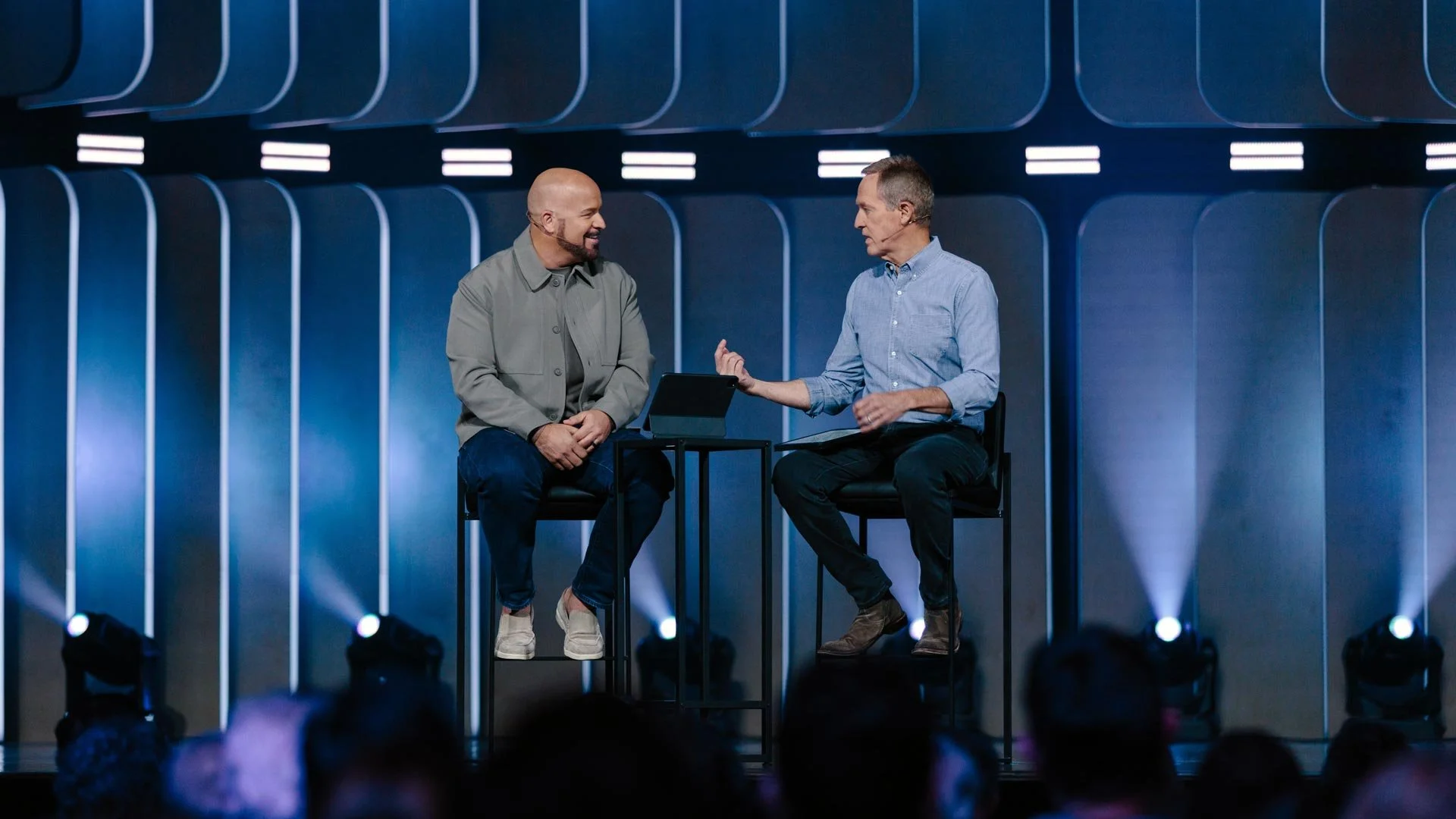
-
Andy:
[So if it's your first time or maybe your first time in a long time, we're in a season of transition. Those of us who are founders of our church, we started the church 31 years ago, we are slowly stepping back in order to make room for a new generation of leaders, most of whom have been here for a few years. They're just a little bit younger, and they get a little bit more running room in terms of their leadership for this church and this amazing thing that we're all doing together. So that's what we've been doing. And for those of you who voted, and if you don't know what that's about, that's okay, but for those of you who voted, thank you so very much. The results are in. And as it turns out, Joel Thomas is going to be the new senior pastor of North Point Ministries.]
Andy:
[By an overwhelming majority, 95.65% of you voted yes. And at Tucker High School, that was an A, so we're just going to give Joel an A or actually an A plus. So congratulations to you and Jenn and your children, because it is a family affair for sure. And you already know that. And real quick, just personally, for those of you who've reached out to Sandra and to me through email, direct messages, X, LinkedIn, Insta, everything, we are so grateful. We've tried to respond to each of you and that's been impossible, but thank you so much. Just your encouragement in this season, it's been absolutely amazing. So here's the thing for everybody watching online. Next Sunday, we're going to be back to our regularly scheduled program. So you're not going to want to miss next Sunday. But to bring things full circle, Joel and I have some things we want to talk about together in front of all of you, some things we want to share together.]
Andy:
[And to set that up, I want to read a passage of Scripture from 2 Timothy. Second Timothy is actually a letter that the apostle Paul wrote to the person that was essentially his replacement of sorts, Timothy. And for those of you who don't read the Bible or you read it occasionally, sometimes it's best when you pick up the Bible not to think in terms of, oh, I'm reading the Bible, but to think in terms of who wrote this and who did they write them to? Who was this written to? And 2 Timothy is one of two letters that the apostle Paul wrote to Timothy. And it's a letter from an older man to a younger man. And the older man is basically passing the baton to the younger man. And the cool thing for me, the Bible nerd, is that Timothy was a third generation Christian.]
Andy:
[Actually, his grandmother was a Jesus follower. We know her name. His mother was a Jesus follower. We know her name. And then Timothy. So he's a third generation Jesus follower, which was amazing because this letter was written only about 35 years after the resurrection of Jesus. But what it means is that Timothy was a church kid. He was a church kid like me, a church kid like Joel, a church kid like not all of you, but some of you, who grew up in church. And again, it's so unusual that this was so early. Again, written about 35 years after the resurrection of Jesus. And the other interesting thing about the letter, Paul writes it from prison. He writes it from prison, and he'd been in prison multiple times, but this time he's in prison in Rome. It's Nero's Rome. And he knows he's not going to get out alive, that this is the end.]
Andy:
[And in this letter to Timothy, he states that. He said, "The end is near." And then he uses this kind of metaphor. He says, "My life is being poured out like a drink offering." And a drink offering in ancient times in multiple cultures, not just Jewish cultures, generally it was a man who would have a cup of wine. And before he took the first sip, he would pour the first inch or so off the top into the sand or into bushes or into a pool or into water basically to say the first bit of this goes to the gods and the rest is for me. And so the apostle Paul says, "My life is about to be poured out into the sand like a drink offering. I'm about to go away and expire and I'll be here no more." And so in the second letter that we have in the New Testament, he probably wrote a dozen letters to Timothy, but only two survived antiquity.]
Andy:
[In the second letter, he gives all this instruction to Timothy about how to lead the church and how to be a good pastor. And it's a very personal letter, and it's full of amazing, amazing things. And the part that I'm going to read is actually a reminder. And this is what makes this kind of personal, and I hope you can feel it a little bit as well. And the part I'm going to read, the short section I'm going to read, it's a reminder that this handoff that I'm doing or this transition to the next senior pastor of our network of churches is just one of a million similar handoffs that have taken place for 2,000 years in nations all over the world between church leaders, and the reason we are here today is because there have been faithful men and women who've led the local church in good times and bad times and hard times and times of plenty and times of famine.] And they've just been diligent, they've done their thing. And then they ensured that somebody was coming along behind them that they could entrust with the next generation of local churches absolutely everywhere. And another way of saying it is this: if you grew up attending church, your pastor was your pastor because another pastor prepared your pastor. That's how it happened. And you didn't think about that. You just started going to a church, and there was a pastor there. You didn't think about who prepared that pastor. And if you were at a local church where maybe you experienced a couple of different pastors, it was the same thing—that one pastor led the way, prepared the way, then stepped out of the way for that next-generation leader. And that's what has made the church a multi-generational, multi-ethnic church that has covered all the way around the globe.]
Andy:
[So what we're experiencing as a network of local churches is in a long line of similar handoffs, and there's something kind of sacred about it, something kind of special about it. And again, we're all participating in it. So here's what the apostle Paul writes to Timothy. He says, "You then my son," he calls Timothy a son, "You then my son, be strong in the grace that is in King Jesus." Strong in the grace, meaning, Timothy, there's going to be some difficult times, some challenging times. And in those challenging times, you've got to step back into God's grace given to you for the strength you're going to need to endure. And any of us who follow Jesus for any length of time have faced times in life where we needed some strength that was beyond our strength. And the apostle Paul refers to that as God's grace, that God will be gracious to you.]
Andy:
[And God's grace—the phrase he uses, you've read this before perhaps—will be sufficient for you, that you will find the strength, you will find the discipline, you will find the ability in him to move forward. He said, Timothy, you're going to need that. And then here's the part that's most appropriate for today. He said, and the things you have heard me say, the apostle Paul saying, the things you've heard me teach, because he traveled with Paul, he'd heard Paul teach on multiple occasions, in the presence of many witnesses, the things that you've heard me preach to congregations, to groups of people, I want you to take those things you've heard from me and entrust them to reliable people who will also be qualified to teach others. So this is what he was saying, because again, the apostle Paul knew all the original apostles.]
Andy:
[This is kind of the first generation in terms of the lifespan of the original apostles. And here's what he's saying. He's saying, Timothy, this can't end with me. Timothy, make sure it doesn't end with you either. Make sure that you are on the lookout for your own Timothy, the person you can hand this off to, the person that will ultimately replace you. Now, unlike Paul, I am so grateful that I didn't have to contact Joel from prison to invite him to rejoin our staff. So Joel, if you'll come at this time, let's have this conversation. Would you welcome Joel to the stage?]
Joel:
[I, too, am really glad you didn't contact me from prison because that would've been a very different transition.]
Andy:
[Yes. Very different. So getting started, I have a list of questions, and I sent them to Joel ahead of time. This was not on the list and it's kind of general, but just overall, how are you feeling about this? And if you're just joining us, two Sundays ago, I made this announcement, and our congregation voted over the last two weeks, and I kind of told my version of Joel's story. So I'm going to let Joel tell his version, but just overall, this is a big deal. It's a family thing.]
Joel:
[Yeah. I mean, I feel great. We've been talking about this for so long, it's sort of strange when you know something's coming for a while, and now everybody else knows about it, and you realize, oh, they're going through the same motions I went through when we first started talking about that. That's interesting. I do have to say, though, when you put that up there on the screen, I was thinking the 4.35% that didn't vote yes. I mean, I feel like if I could spend time with them, they would like me. Don't you think?]
Andy:
That's because your personality is different than mine. I think they would. And here's the good news. See, in order to vote, you had to put your name and your email address, so we can send you all of their email addresses and you can reach out to them one at a time and see if you can get them to like you, or we could just find out what area of town they're in and you could invite them all over to your…
Joel:
[Gatherings.]
Andy:
[A gathering, and just kind of…]
Joel:
[Try to win them over.]
Andy:
[Try to win them over. And I'll be busy that night. But anyway, but to know you is to love you, you're right. And they probably moved out of town or something. I don't know. It was an accident. They probably just…]
Joel:
[They clicked on the wrong thing. I think that's what it was.]
Andy:
[So my first actual question is, as I talked about two weeks ago, this is the second time you've replaced me. You were the first person. I stepped out of my role as lead pastor of this church. You stepped in and people said, "Hey, don't do that. The person that follows the founder, it never goes well." And it went incredibly well. Similar feelings, different feelings, do you remember?]
Joel:
[I wasn't somewhat concerned. I was terrified the first time. And you hear this all the time, and I was one of the people who would say it. Who wants to follow Andy Stanley at anything? And I didn't even want to think about it that way. You mentioned this. We called it the body-bag job. It's like whoever's going to follow that job.]
Andy:
[Bill Willits told you.]
Joel:
[Lots of people talked about that. And I think I felt that in the beginning, and I've heard people say, "Whoever has to do that, that's going to be not a fun job." But I really feel like this time it's different. Having done it once, and I think I figured out, and by the way, I have to say this, Andy gave me the questions. I did not give him my answers. So it's going to feel like he set me up to say nice things about him, but I'm just telling you how it happened. I feel like I get to follow you, not I have to. And this is why I say that, this is a principle. I think there’s a book written on this, the wake of leadership. Leadership has a wake, and that can be good, it can be bad. Sometimes people's wake, their leadership, is good. Sometimes it's detrimental. And I think it depends on whether you're inside or outside the wake. If you're outside the wake, you can get swallowed up. But I feel like you have so helped me. You've done this not only with me but many other leaders. You've allowed us, and not just you, but the other founders, I was so glad you talked about them last week. You guys cut through a lot of the turbulence and a lot of the waves, and you have created a wake, a safe space behind to learn and to grow, and you pulled us along behind you. And so I don't feel as much terrified as grateful that we're doing it together. I'm grateful you're not going far. You're going to be here, you're going to preach, and I love it that your family's all engaged here. So that's my reaction to that.]
Andy:
[Alright. So thank you.]
Joel:
[You're welcome.]
Andy:
[I hope that's true. I appreciate that. I mean, I want to be that kind of leader, and you're that kind of leader as well. We could talk about that. So the other thing I talked about two weeks ago is, I gave the church my version of our conversation when you came to me 12 years ago. Twelve years ago, Joel was leading this campus. He was doing great. He did a huge fundraiser, got the whole front of our building built, helped design and create all that. I mean, things were going well. And then we're having lunch one day, and he tells me he'd preached a few times at his church in Arizona, and they called him to be their pastor. And I remember you said, "Please tell me I don't have to do this." And in that conversation, I just got the sense, "Oh no, Joel is supposed to go do this." So I gave him my version of that story. That was a defining moment.]
Joel:
[So personal. And places are important to me. I can literally take you all to the booth at Village Tavern. I know exactly where I was sitting. You had always said, and this is true, this has been true since day one, you've always said, "Hey, if you have another opportunity, if you're considering another opportunity, if somebody reached out to you about it, you don't have to whisper about that. You're not going to be out of a job because you're considering something else." We didn't want to have that type of organization. You set the pace for that. And so I was taking a risk, what felt like a risk to me. I didn't know what to expect, how you'd respond. And I just have to tell you, I know because we're a large church, in large churches, not everybody gets to experience this, but that day you pastored me. You sat across from me. You were not thinking about your thing or how this was going to affect you. Or if you were, you didn't show that to me. I sort of told you about the opportunity, and I did say, "Tell me I don't have to do this." And you basically laid it out. And if you haven't heard this, we talked about this on Andy's podcast years ago, but the short of it was you said there's three options. It's either this is something you’ve got to go do, you feel like you’ve got to go do this, and it's something you want to do. You’ve got to go lead your own thing, and that's okay. If that's okay, you don't have to be shy about that. I understand that. It could be that you think this is a better opportunity, and you knew a little bit about the opportunity. You were like, "This is not a better opportunity, but if you think it is, okay, that's another option." And then you said, “What this feels like is something that God's calling you to go do. And sometimes it doesn't make sense, but it seems like God's being clear with you. You just have to decide if you're going to be obedient or not." And I remember for Jenn, that was the moment where it was like, "This isn't about career change. This isn't about leading a church. This is about, are we going to be obedient to do what God's calling us to do?" And you really pastored me through that. In fact, you were so neutral. I remember this. You called me later and you said, "Hey, I was telling Sandra about our conversation, and she said to me, ‘Did you tell him you want him to stay?’” Because you were so neutral, and you were just trying to help lead me towards the best decision, and your kindness didn't end there. We continued to talk. I mean, you answered my calls. I created a problem for you by leaving the space. There were a lot of dominoes that moved around after that, but you'd answer my phone call. You helped me in difficult times. In fact, the other space I think about was, there was a parking spot outside of a grocery store in Arizona. And you remember this, one of the hardest points of the season.]
Andy:
[And for those of you missed it, Joel was there for seven years and walked into a really difficult situation.]
Joel:
[And Andy helped me. There were several times he was like, I've never done that. I don't know what to do about that. But this one time I sort of had some intuition around this is what I think I need to do, but it was sort of a precarious thing. And he was so encouraging in that. And not only that, I sat there. It was on a Tuesday, and I know his schedule on Tuesday. He does not have time on a Tuesday. And I sat in that parking spot on the phone with you and you helped me write a sermon. You helped me write the communication that was one of the key things that helped things turn at the church there. And you were just such a great friend and so many people in this organization. It's one of the reasons why we joined the network. I was trying to do there what was happening here, and so many of our leaders helped me do that there. You were such a great friend to me when you didn't have to be, and I was super grateful for that.]
Andy:
[Well, you did leave me with a big hole in the organization, but that was fine. No, but it's true.]
Joel:
[You never made me feel that way though.]
Andy:
[Well, it was one of those moments. And there's an application for all of us. Every once in a while, if you follow Jesus, not every month or every year, every once in a while there's just an, oh my goodness, this doesn't make sense. I don't know how I'm going to explain this to my parents. I don't know if my spouse is… this doesn't make sense financially or this doesn't make... But you just know you’ve got to go. And it's rare, but when it happens, Jesus gets real, your faith gets really big. And as you told me about that opportunity, what was happening at the church, I just remember sitting there thinking, oh no, this is one of those, and it's going to be hard for Joel, and his family's going to have to move, and you live in the same neighborhood as your sister and her kids and your cousins... But we just knew.]
Joel:
[And I was hoping, I saw it in your eyes, and I was like, oh no, no, no. This is not the answer I was looking for. I was looking for you to sort of give me a pass on this one.]
Andy:
So then about six and a half years later, our lead pastor at Buckhead Church left. And you and I, through the years, talked, "Hey, maybe one day you can come back, but you're doing an important thing there.” I wasn't going to try to hire you away. Mandy, Joel's sister, who's worked for us for 25 years, every other month or so, I'd see her in the hall. She's like, "When are you bringing Joel back?" I'm like, "Mandy, he's doing great things." So we had those conversations, and then I called you and talked a little bit about that because your family settled. Y'all had two children out there, you turned the church around, things are going great, you'd settled in. This was home. I'm like, "Hey, Joel, I've got a big something somebody needs to do. I'd love for you to do it.” Take it from there.]
Joel:
[It was interesting because when we first got out there, it was so hard. I'd hope we wouldn't be there long. There's part of me that thought, "They're not going to keep us here long. They're going to probably kick us out." But the longer we were there, we never thought we'd leave. I never thought we'd leave. It had become home in every sense. But you didn't know this when you asked me the question, because we had talked about other opportunities along the way, but this time it felt different. And you asked me something that was actually triggering for me. You said, "I just want to know, are you open to ever coming back?" And the first time, for those of you who don't know the story, I was not open at all. In fact, as the Lord started making this clear to us that this is what we're supposed to do, I was like, "Oh no, I don't want to do that." In fact, Jenn was bothered that I wasn't open. She didn't want to go, but she was bothered that I wasn't open to it. To coming.]
Andy:
[Back, you mean?]
Joel:
[No, to go the first time.]
Andy:
[There.]
Joel:
[You had to go there the first time. And so when you said, "Are you open to coming back?" I thought, "Well, last time I wasn't open, God sent us to the desert, so I should probably be open." So it was one of those things that I just knew we should be open to this. And I was honored and humbled by the invitation, but we decided we were going to get our “bigs” together. We have “bigs” and “littles,” two older kids, two younger kids, and we put the littles to bed because they were too young to have this conversation. And our two older kids, Talon and Gentry, it was early summer. He was about to be a rising ninth grader going into high school, and my daughter was a rising eighth grader. So we sat down, we had these four leather chairs. We sat down, it's kind of close quarters, and this is where we'd have family meetings and conversations. We sat down and I basically laid out, I said, "Hey, Mr. Andy called and here's the opportunity." And of course their context for Alpharetta was, because they were little when we moved, was their cousins were here. Talon was in second grade, and Gentry was in first grade when we left.]
Joel:
[I said, "Hey, we just had this conversation yesterday. We're 50/50. We want you guys to pray with us that God would make it clear what we should do. We want to be open to what God has for us." Gentry immediately spoke up, our daughter, and she's sort of adventurous, and she gets excited about stuff. She's like, "Well, I think it sounds exciting. I think I'm 60/40." She just jumped in with her percentage. Talon was kind of quiet. We talked about that for a minute, and so I had to call on him. I was like, "Hey, what do you think, Talon?" Because he’s a little more reserved. He's like his mom, he's very thoughtful, and he's a thinker. He said, "Dad, are you guys really 50/50?" I think he was sort of like, "Don't ask me to pray for this if you've already decided." He was like, "Are you really 50/50?" And I said, "We really are." "Okay, if you're really 50/50 and you want me to pray for this, I'll pray for that because the last time we followed God and did what he wanted us to do, it worked out pretty good for us." He was just old enough to remember when we moved the first time.]
Joel:
[We don't realize that our kids pay attention. He was paying attention to all that. He knew that we were saying this is what God wants us to do. It didn't make sense. We're moving away from your cousins, all that. He remembered all that and he remembered how God protected us and guided us, and he just said, "I want us to do what God wants us to do, and so I'll pray for that."
Andy:
[If I can just address our audience for a minute. This is so important. Dads, as you're making big decisions, you can't really involve your kids too early. And if your kids see you inviting God into the big decisions in life, whether they understand the ramifications of those decisions or not, because when Joel told that story a few minutes ago at the first service, I just remember our family, the four of us, my sister and my parents, kneeling around this little table in our den one time. There were multiple times, and at one time in particular, trying to make a big decision that was going to impact the whole family. And my dad invited us in and explained it to the level we could understand it, and we all prayed together. I still remember those moments, and those are moments we can't afford to miss as parents. And here you are telling the story and the wisdom that came from Talon that night, that was…]
Joel:
[It's remarkable. I could have never taught him that lesson.]
Andy:
[No. You modeled it.]
Joel:
[And he just saw how God worked in that.]
Andy:
[So one more thing on this, and we’ve got to move on. So this may come as a shock, but pastors, male pastors, men, we have egos. I mean, I do. Do you?]
Joel:
[Yeah.]
Andy:
[I tell people, look, just because I'm a pastor, I was a man first and a pastor after that. So there was a sense in which this was kind of a step down. You were the lead pastor of a large church. You had influence in the community. You had networked with other pastors in the community. You joined our network. I mean, you were doing your thing. So to come back here and then have another boss, you had a board, but now you're going to report to me. It was kind of a little bit of a step down. Did that factor in at all?]
Joel:
[Yes and no. I think I even said to you at one point, "I think I'm going to drive you crazy." And you're like, "Well, why?" I was like, "Well, I do your job here, and it's kind of tough to gear that down." That's what I mean. It was an adjustment, but I think more important than that, and you and I have talked about this, I think you just never go wrong when you get super clear. That was our first, that lunch. I was trying to get somebody to talk me out of or give me a pass, tell me I didn't have to do this. But when you get super clear on what God, and you know this, you've experienced this, in your marriage, in a situation of conflict, or with your kids, you know in your heart, this is exactly what God wants me to do. And you have resistance because of all good reasons, you have all these reasons. I think, though, when you've experienced before, you follow God in a situation where it didn't make sense, and he showed up in a way you can't explain, and our family couldn't have experienced any other way, when God gets really clear. If you've experienced that before, you just take the step because you know what's on the other side of it.]
Andy:
[And somebody here today, watching today, this is for you because you're not in ministry specifically, you're not a pastor, but you're facing one of those things, and you're trying to talk yourself out of it, and it won't go away. You’ve just got to pay attention to that. The thing is, you don't know unless you go. You don't know what you missed out on. You don't know what could have been unless you say, "Okay, God, I'm all in. I'm just going to do this." Even though, again, it doesn't make sense. And fortunately, those aren't weekly or monthly or annual events, but every once in a while.]
Andy:
[Sort of on the same topic, in week one, I shared this statement that you said to me when we were on the phone after you and your family had navigated this and talked about it and prayed about it. You agreed to come back, and you said this, "Jenn and I feel called to help North Point become the next version of the church God wants it to be, and that the community needs it to be, regardless of what our role is." So I kind of unpacked that two weeks ago, but you all actually wrote that out. That's an actual quote. Anything you want to add?]
Joel:
[I think in some ways there's part of me that felt like, as we were praying through this, there was part of me that felt like this did feel different. It was unique. And that quote in the context of what you invited me back to, because you invited me back to be the lead pastor at Buckhead Church, doesn't seem like it makes sense. But I had a friend, a mentor at the time who's very wise, who said, "Hey, here's what you should do. You should ask Andy all the questions you can't ask him when he's your boss." Which I thought was really good advice like, "Hey, find out exactly what you're getting into." Most of you know this. If you're going to a company, you want to know if you're going to go somewhere. I mean, I had only changed jobs once before to a different organization in my entire career. I want to know, what does the future look like? How long are you going to be around? What's next? And so I asked you a whole bunch of questions that I probably didn't have the right to ask you, and you had answers for a lot of them, some of them you didn't have answers to, but you gave me enough of a sense in those conversations that I was going to have the opportunity to help shape and have a voice at the table for what the future looks like. I didn't see this, I didn't know all that obviously, but I felt like I'm going to have an opportunity to influence that. And because of our experience with this organization, Jenn worked here for over a decade, and the impact we saw it have in our church in Arizona and throughout the network, and so many friends and churches around the country and around the world, I just thought, "Why wouldn't I want to help this church in this season when we're trying to figure out and imagine what's next, and how do we continue on this mission together?" So it just felt like a good opportunity.]
Joel:
[And you said something so personally. You said, "I need your help." I never heard you say that before. Not that you didn't want it, but you kind of talked to me about my experience previously at Buckhead Church because I had been on staff there when we were in the grocery store and moved into the building and then my experience in the organization, understanding the organization, and coming out of the pandemic, it was tricky, especially in the city, and my experience at Mission. You identified all three of those pieces, and I heard you communicate, "Hey, I think you're uniquely positioned for this job. Doesn't mean you have to do it. You told me I don't have a plan B. It doesn't mean you have to do it, but I really think if you pray about this, I think you'd be the right fit for this." It just felt different.]
Andy:
[I remember telling you this, I said, "I hope when you come back, if you come back," or by this point you had said you would, I said, "I hope that over time, your influence with our staff and your influence in our churches precedes the opportunity for you to have more positional authority, but it's going to have to start with influence." I'm telling you, I saw almost day one when you sat with our directors and our other lead pastors, you brought a perspective that none of us had because none of us had done what you did at Mission, and you just had a moral authority. That I knew you had, but to see that kind of blossom with our other lead pastors who'd been here long, it was just amazing. And you handled that so well, and you leveraged your influence even when you didn't have position.] And that's just the mark of great leadership. So early on, I'm like, oh my goodness, God, thank you that Joel and Jenn said yes. I appreciate that so much.]
Andy:
[So I'm going to skip down to the elephant in the room question. Is that okay? So in every industry, there's kind of insider stuff. So here's a little insider preacher stuff that I think we should talk about to all of you, to all of our churches, because this is a dynamic that happens in churches when someone follows a founder or when somebody follows a pastor who's been there for many, many years. So we just call it the elephant in the room. So these are the kinds of concerns that people have warned you about that I know we should be warned about because of church history and growing up as a preacher's kid. One, there's concern about the founder sticking around like I'm sticking around. People doing the end run like, "Hey Andy, we really like Joel. Hey Andy, Joel's doing this thing." So that kind of stuff happens. There are not a lot of success stories of the second person coming in and the person in my position sticking around and wanting to help or being on the board. And you have had a unique window into some of those more recent transitions. So just talk about your concerns about that. And one of the reasons I'm saying this is so that all of you can take into consideration, oh, this is kind of a big deal. And I know you're all so committed to what we're doing locally, nationally, and globally, but because of our influence, it is so important, not just for us and not for just for our church, but for other churches that this goes as well as it can possibly go to the point where both of us have said to each other, “Hey, if I'm a problem, I'm out because what God is doing through us together, there's no way in the world either one of us wants to be the problem or to be a hiccup in all of this.”]
Joel:
[Yeah. In fact, I told you that. I said, "Hey, if we get sideways, I'm out." And you were like, "No, I'll quit first." I was like, "Well, we can't both quit."]
Andy:
[No, I told the board, I said, "When I become a problem, because you know the old guy…" I said, "Please tell me, call Sandra. Do not let me… because we know what happens." Anyway.]
Joel:
[Well, and what you won't say, because you're so kind, but people need to know, we've seen a lot. Some of your peers and contemporaries and other large multi-site churches have not done this well. And it's not only been bad for them, for their legacy, but for the leaders behind them and the whole church. And I know you cared way too much. Andy mentioned I was in this cohort. I was in this succession cohort, and I got invited into this group, and they're all successors of large multi-site churches. Some of them had already taken over churches. Some of them were yet to take them over. And I got into this cohort, I'm not exactly sure, I think it was because this was while I was still in Arizona, I got into this group, and I was in a context where it was not a planned succession. All these other guys were in these planned successions. And little did I know, this is God's providence. I was in this group because of this. And it was before any of us had ever thought about that. But we would go around and meet with all these churches, and we were trying to learn from their succession. It was always post-succession. So we would meet with the founder or the predecessor, we'd meet with the successor, and then we would meet with the executive team, which is where we'd get the real story. And so what happened was, what I realized quickly was when we'd meet with all these groups, when people told relatively the same story, all three groups, it was really healthy. But sometimes the founder or the predecessor would say this and then the next day they'd be like, "Oh, they told you that? That's not how it happened. This is how it happened." Then the executive team would be like, "Neither one of those is the way it happened. Here's how it really happened." And one of the things, all that time I realized the common denominator, and again, this is dozens of these, I realized that the key to the succession thing was really the relationship between the outgoing pastor and the incoming pastor. That if there was a strong relationship there, there was mutual respect, there was not just comradery, but a willingness and a desire to work together to steward a transition that the rest of the stuff, it's more contextual. It depends on your context and how you hand that stuff off. And so I felt I was so grateful that you were not only committed to our relationship, and we've been meeting twice a month for breakfast for the last four or five years, most of the time, many of the times without any agenda items, just to continue to grow in our relationship or maintain our relationship, and keep short accounts.]
Joel:
[And you've always been so interested. Every time I'd come back from one of these gatherings, cohort gatherings, Andy would be so interested about, "Hey, what'd you learn? What can we learn from that? How can we implement that?" And you were curious in the business world. We met with Dan Cathy and Tim Tassopoulos who helped with Dan's transition to Andrew. And then we met with Frank Blake who talked about his transition at Home Depot. And I just felt like you were such a student and a learner. And I just think a lot of those things, just naming them out loud that could go sideways. I didn't say this in the last service about you being an elder. People were like, "Are you worried about that? Are you worried?" People will look to Andy in the meetings, in the elder meetings. And I'm like, "Well, one, they should look to him. He's our founding pastor. I mean, for 31 years he's been steering our church, and might I say in a really good direction." And so they should look to him. But I think one of the things for me is I would rather them look to you in the meeting than outside the meeting. And I don't think anyone would go to you outside, but I would rather them look to you because even as you've handed off things to me regularly, as people have looked to you in those meetings where you've handed leadership to me, you've continued to look to me. And I'm super grateful for that. You have modeled healthy leadership, and I just have never felt unsupported by you.]
Andy:
[Well, as I said in week one, this is the part of Joel you'll never see unless you sit at a board meeting or at a directors’ meeting. Joel is a phenomenal organizational leader. And three years ago when I handed that point leadership off to him, the changes he's made in terms of staffing, staff model, multiple things, they're all great. They're all good. So that part of it, the reason I look to you in those meetings is, I feel like you have better intuition than me with some of those things. So that's not been a discipline. That's been easy. So now the question that some of our congregants are asking, “Okay, so what's going to change?” What changes? What's going to be different?]
Joel:
[It's a good question. It's funny when you first sent me the questions, I actually chuckled out loud when I read this because I thought there's some people that if they miss these three weeks, they're going to show up later in November and December, and January's going to come and they're going to have no idea there's any leadership change that's happened here. And part of that, we want it that way. It's because we like the way things are going. And at all of our churches, we have strong lead pastors at those churches. So much of the local leadership that happens is so great, and we don't want to create a disruption. We are always asking questions about how can we get better? What needs to change? And we're doing that now. There are conversations we're having about cultural change, generational change, how should we respond to that? But that's not new. We've continued to have those conversations, and things will evolve and change. But right now, we're not focused on any structural or specific strategic changes or programming changes because the leadership change is enough. And we've been having discussions within our staff, we're working through a book about transitions, and managing the change internally is enough with the staff. We have a large staff, and they're going to feel it. Most of what's going to be felt is at the staff level, probably not at our average church person's level. So we're not really focused on creating big change. If people are expecting something brand new and different in January, I hope you want a lot to stay the same because I love our church and I love the church experience I'm having and my family's having. So hopefully you do too.]
Joel:
[So here's something I wrote in my notes. I think people are wondering, we're also focused on a big vision. We cast vision about two years ago, started meeting with people, and cast a vision. In January, we had these vision nights, and we had vision nights at all of our campuses. You and I traveled around to all of our campuses. And it was so funny because when we first sent out the email, come to this vision night, and me and you are going to be doing this, everybody's like, oh, this is when Andy's going to announce his retirement. And that was sort of the thing people were whispering about.]
Andy:
[I think that's why they showed up.]
Joel:
[So people show up, and at the end of that event, actually at the end of the first one, I didn't have your permission to say this, but I just decided sometimes I say things without thinking and it gets me in trouble. Sometimes it's good. So I just said, hey, I just want to speak about the elephant in the room. We got to the end of that night, cast this big vision. I said a lot of you thought you were showing up and Andy was going to talk about his retirement. Little did you know, he's stepping on the gas pedal. Now here's why I say that, because at that time you already knew about your 69th birthday. You and Sandra had pre-decided, but you wanted to step on the gas pedal. Talk about that and why? Why were you okay with me saying that? Because you continued to let me say that.]
Andy:
[And part of my concern with all this was, wait a minute, we're raising all this money to do all this big stuff and you're leaving? This is why if you didn't hear my message last Sunday, last Sunday it was important to me to say, here is why it is strategic for our future for me to hand off this level of leadership now. It is because of my commitment to the future of our vision of what we're doing locally, nationally, and globally. And for two years, we're raising money. And for those of you who've given to Deeper/Wider, for those of you who continue to fulfill your pledge, for those of you who haven't started yet, but I know you're getting ready to by faith, the two-year give, a five-year investment, but 10-year impact. I don't need to be in charge of this organization in 10 years. And in 10 years, that's not the time to make a transition anyway. So if we really are committed to what we have decided, we need maximum horsepower in terms of the leadership of the organization with vision beyond 10 years. Not, oh, we did something and now we're finished. And so for Rick and Lane and Bill and me, the four founders who are still here, our commitment to that is why we're stepping back. It is strategic. It is not a lack of interest. And I don't mind saying this. Sandra and I's financial commitment to Deeper/Wider is far larger than any financial commitment we've ever made to anything at the worst possible season of our life. When you see the end of a paycheck on the horizon, and you've committed to giving this much money away. But you know what? Part of it was when I saw the level of giving some people in our churches were doing, it's like we just kept ratcheting ours up because we are so committed to this. So when I step out of being an employee, at that point, I've said to the elders and to Joel, put me in coach. What do you need me to do? You need me to preach? You need me to serve on a board? You need me to travel? You need me to help recruit pastors? Leverage whatever influence I have for the sake of what we're doing because it is such a big deal. And this past week we were with what, how many pastors?]
Joel:
[Almost 200.]
Andy:
[Almost 200 pastors at Buckhead Church for three days and from all over the country. It was just our stateside pastors, but several of our international pastors showed up anyway, I think uninvited, but we love having them. But it's a lot of travel.]
Joel:
[They're always invited.]
Andy:
[They're always invited. And I'm telling you, to see the quality of leaders we're attracting that are doing hard things in hard places, but are saying, "Hey, go, go, go." It is such a big deal. So we are as committed as we've ever been, so much so that it's better for me to get out of the way, so to speak, early rather than later. And I have no doubt that you're the guy to carry us forward, and 10 years from now, call me at home, tell me how it's…
Joel:
[Going.]
Andy:
[If I'm not around. Roll me in.]
Joel:
[Well, the thing is, it's fun because we knew that on the front end, and it was like, this is so big. We need to do this together, and it's going to require all of us. And I'm grateful for your commitment to that. And if I could just say one more thing, I know we've run out of time. So years ago, I'm just so grateful. Andy, you've been so thoughtful, so intentional, so humble, so open-handed in all of this. And the other day I was reminded, we were having a conversation, and I was reminded when I left here to go to Arizona, we have a tradition here in our organization. When people leave, whether they're going to another organization or they're retiring, we usually, in their team, we give them an opportunity to say, "Okay, now you're on your way out. You basically can say whatever you want. How would you challenge us, or how would you encourage us?"]
Andy:
[Give us your parting shot.]
Joel:
[Hopefully it's not a parting shot, but yeah, sometimes it is. It's like, "Hey, this is what I wish I could have always said, and now I'm going to say it." Usually it's constructive, and people are for us. And I remember agonizing over this. I felt like the Lord wanted me to share something, and I thought, "I'm not the person to share this, especially not now. I didn't want anybody to think I was ungrateful." So in our lead pastor meeting, you were sitting at the end of the table. I was sitting down here, and I remember my palms were sweaty, as I knew we were getting to that part of the meeting. And I had stayed up the night before, I don't know if I ever told you this, agonizing over how exactly to write this. I didn't want it to be offensive, but here's a statement I put in my notes. And I included myself because I wanted…]
Andy:
[This is 12 years ago.]
Joel:
[Twelve years ago. Twelve years ago in December, we were sitting in the conference room, and I said, "This is what I feel like the Lord wanted me to share with you, that we should not allow the finish line of one generation to impede the progress or momentum of the church for the next generation. We should not allow the finish line of one generation to impede the progress or momentum of the church for the next generation." And I watched you write it down. You personalized it. You later put it on your desk, and you did it. And for the fact that you personalized that, and you took it so seriously, and you said, "I don't want my finish line to be the finish line for this mission, what we're doing is so important.” Twelve years later. Sounds self-serving, but on behalf of our staff, our churches, and our mission, thank you. Thank you. Thank you.]
Andy:
[So I did, I took that statement, and I typed it out. I will not allow my finish line… Typed it out in about an 18-point font and hung it in my room where I have all my books, and I've looked at it every week. Really anytime I'm in there looking at something, it's looking at me, for 12 years. And it really was like a north star as I considered this point in time, which of course 12 years ago felt like it would never get here. So thank you. So I'd like to close by praying for you and I hope that you will commit Joel and Jenn and their family to prayer as well because a weight is lifting off of me slowly, and it's going to settle right there. Good luck. No, I'm just kidding.]
Andy:
[We're so fortunate to lead amazing people doing amazing things. But if you would, let's pray together. Father, we are so grateful, and thank you for bringing Joel. First, thank you for bringing Joel during the Olympics in such a strange way, to bumping into our church, joining our staff. Thank you that he met Jenn. Thank you for bringing Jenn to our staff, an incredible investment she made for 10 years, and for Mandy, 25 years. So for the whole family, for their amazing kids. And I do pray that you would give him eyes to see this organization the way that you see it and the courage to lead it the way you want it to be led regardless. And so I just pray that your Spirit would guide him beginning now. Thank you for our friendship. I pray that you would help both of us protect that. And I pray that in some good way, that we, as a congregation and as a group of congregations, would model for church leaders what could be and should be as it relates to this. Thank you for the privilege of being in a long line of handoffs that have ultimately allowed the church to spread all around the world. In Jesus's name. Amen. Thank you, Joel. Thank you so much.]
© 2026 Andy Stanley
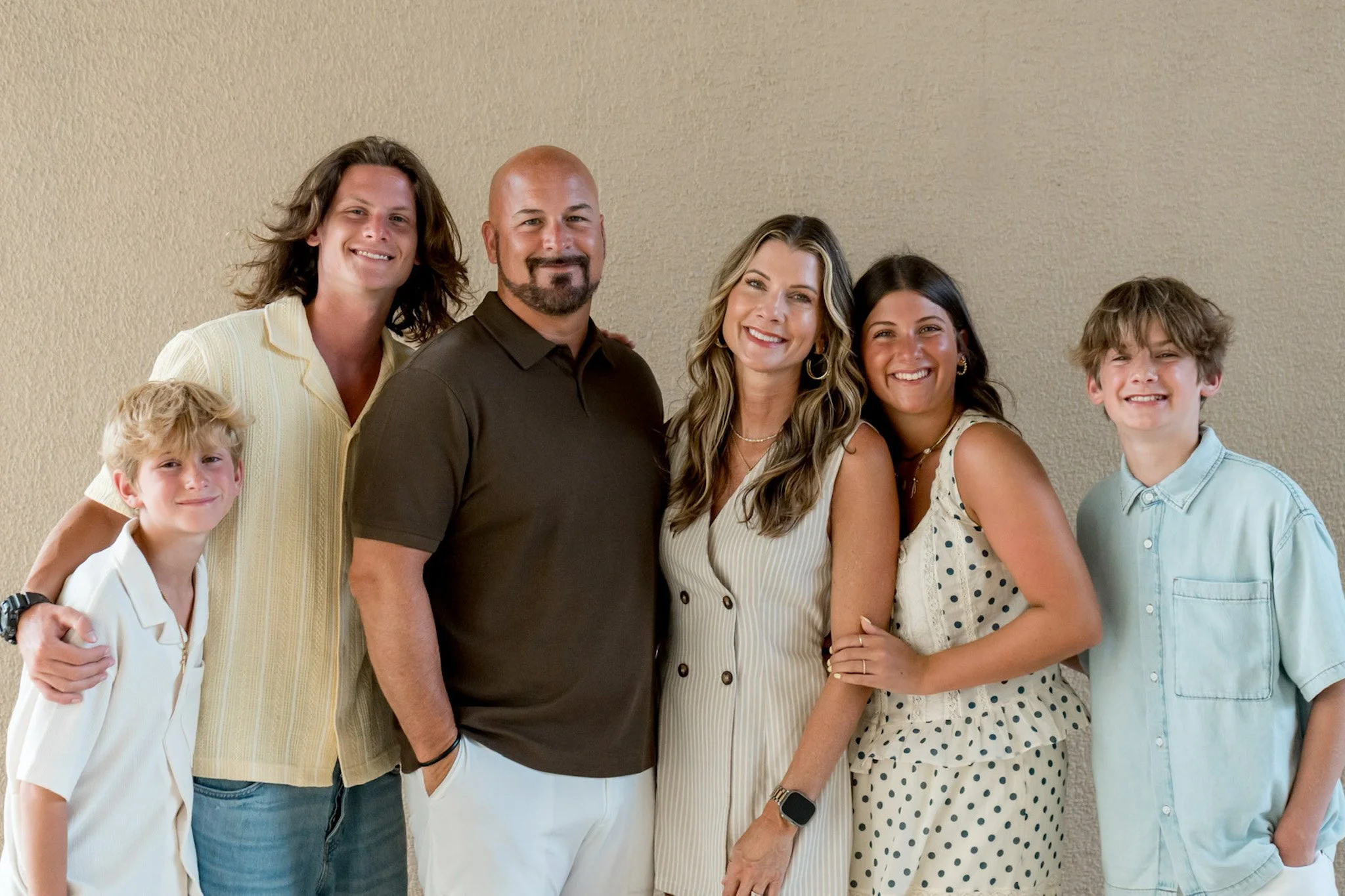
Meet Joel Thomas
Joel Thomas will serve as Senior Pastor of North Point Ministries, effective January 1, 2027.
Since 2023, Joel Thomas has served as the Executive Director of North Point Ministries, providing point leadership for the NPM Directional Team and oversight for our entire network of churches.
Joel began his ministry career as the first intern of North Point Ministries in 1998, then served in college, singles, and married adult ministries before becoming Lead Pastor of North Point Community Church in 2011. In 2015, Joel and his family moved to Arizona, where he served as Senior Pastor of Mission Community Church for nearly seven years. In 2021, he returned to the Atlanta area to rejoin North Point Ministries and lead Buckhead Church, where he served for five years. During this time his responsibilities expanded to include serving as Executive Director of North Point Ministries.
Joel and his wife, Jenn, aspire to finish life together having experienced an abundance of faith, love, and fun along the way with their four amazing children.
Important Milestones
A Timeline of Key Dates for These Leadership Changes
October 18, 2026
Proposed changes for North Point Ministries are announced. Voting opens for all eligible voters. Voting closes October 30.
November 1, 2026
Joel Thomas is approved as the new Senior Pastor by congregational vote.
January 1, 2027
Joel assumes the role of Senior Pastor of North Point Ministries.
Confirmed
June 1, 2027
Joel assumes the role of Lead Pastor of North Point Community Church.
Common Questions
Answers to the most frequently asked questions about these leadership changes
-
Andy is not retiring from ministry. He is resigning his roles as an employee of North Point Ministries.
-
The Board of Elders voted unanimously to appoint Joel Thomas to succeed Andy as the Senior Pastor of North Point Ministries. Joel was confirmed by congregational vote and will assume the role on January 1, 2027.
The plan is for Joel to become Lead Pastor of North Point Community Church on June 1, 2027.
-
The Senior Pastor is the “CEO” of the organization, providing spiritual and directional leadership for North Point Ministries, its local campuses, and its national and international network of churches. The Senior Pastor reports to and is accountable to the Board of Elders.
A Lead Pastor provides point leadership for a specific campus of North Point Ministries.
-
January 1, 2027: Joel assumes the role of Senior Pastor of North Point Ministries.
June 1, 2027: Joel becomes the Lead Pastor of North Point Community Church.
-
Andy will continue to participate in the preaching rotation and serve on the Board of Elders.
-
Andy will continue to participate in the preaching rotation.
-
Please watch Andy’s message from October 18, 2026.
-
The organization’s constitution outlines a few decisions that require a vote of the church membership. One of those decisions is the appointment of a new Senior Pastor.
On October 18, 2026, church members received an email with a link to a ballot page, where they could cast their vote. Voting continued through October 30, 2026, at 5:00 p.m. The results were announced on Sunday, November 1, 2026.
-
The Board of Elders determined an eligible voter is an individual 18 years of age or older who satisfies one or more of the following:
(a) Has been active in a small group at any time in the last 18 months
(b) Is the parent or guardian of a child who has been checked into one of the church’s children’s environments in at least 12 of the last 18 months
(c) Has served on a ministry team at any time in the last 18 months
(d) Has contributed financially to North Point Ministries four times or more in the last 12 months
If you have been identified as an eligible voting member, you will receive an email on Sunday, October 18, 2026, with a link to submit your vote.
-
The results were shared during services on Sunday, November 1, 2026, and posted on this page.
-
The mission and vision of North Point Ministries and its campuses will remain unchanged. We will continue to inspire people to follow Jesus by engaging them in the life and mission of their local church.
-
Updates and additional details will be posted on this site as they become available. If you have an immediate inquiry, please email update@npm.net.
Updated November 3, 2026, 4:17 p.m.